Written by the Refrigeration Team, specialists in refrigerant gases and EU F-Gas compliance. Last updated: 16 September 2026.
R-134a carries a GWP of 1,430 under Annex I of Regulation (EU) 2024/573. That value sits below the 2,500 threshold behind today’s servicing bans, and above the 750 threshold that will apply to stationary refrigeration in 2032. The whole future of the gas plays out between those two numbers, and most of the timelines circulating online collapse two entirely separate mechanisms into one.
Key Takeaways
Is R-134a banned in 2026?
No, on neither track. R-134a can still be bought, sold and used to service existing systems in 2026. The use restrictions in Article 13 of Regulation (EU) 2024/573 target gases with a GWP of 2,500 or more, and at 1,430 R-134a falls into none of them. What is tightening is supply, not legality.
The EU HFC quota caps placing on the market at 42,874,410 tonnes of CO2 equivalent for 2025 and 2026, roughly 24.3% of the 2015 reference value of 176,700,479 tonnes set in Annex VII, then drops to 21,665,691 tonnes for the 2027 to 2029 period. That trajectory and how the quota is allocated are covered in our EU HFC phase-down timeline. For the wider picture of what F-Gas III changed across all refrigerants, start with our F-Gas Regulation guide.
New equipment: the real Annex IV dates
There is no single date. Annex IV splits placing-on-market bans by equipment category, each with its own GWP threshold and its own deadline. For R-134a at GWP 1,430, only the rows with a threshold of 1,430 or lower actually bite.
| Equipment category | GWP threshold | Date |
|---|---|---|
| Domestic refrigerators and freezers (point 2(a)) | ≥ 150 | 1 January 2015 |
| Domestic refrigerators and freezers, all fluorinated gases (point 2(b)) | All | 1 January 2026 |
| Commercial centralised multipack systems ≥ 40 kW (point 6) | ≥ 150 | 1 January 2022 |
| Self-contained refrigeration equipment, chillers excluded (point 4) | ≥ 150 | 1 January 2025 |
| Other refrigeration equipment, chillers excluded (point 5(c)) | ≥ 150 | 1 January 2030 |
| Chillers ≤ 12 kW, all fluorinated gases (point 7(c)) | All | 1 January 2032 |
| Chillers > 12 kW (point 7(d)) | ≥ 750 | 1 January 2027 |
One misreading keeps resurfacing: presenting 2032 as the date new stationary refrigeration equipment with a GWP of 150 or more can no longer be placed on the market. That row does not exist in Annex IV. The only 2032 entries in Annex IV cover chillers of 12 kW or less (point 7(c)) and self-contained air conditioners and heat pumps of 12 kW or less (point 8(c)), and both target all fluorinated gases with no GWP threshold at all. Neither covers stationary commercial refrigeration. The other 2032 date, the one that genuinely reaches R-134a, belongs to a completely different mechanism covered in the next section. For the bulk of stationary commercial refrigeration, the placing-on-market date to plan around is 1 January 2030.
2032: the real deadline is about servicing, not sales
Article 13(5) sets the only cut-off that lands directly on R-134a: from 1 January 2032, Annex I gases with a GWP of 750 or more may no longer be used for the maintenance or servicing of stationary refrigeration equipment. At GWP 1,430, R-134a is in scope. Nothing in that provision stops anyone selling, buying or owning the equipment itself.
Three qualifications change what the rule means on site. First, chillers are explicitly excluded from Article 13(5). Air conditioning and heat pumps aren’t named at all, simply because the paragraph only reaches stationary refrigeration equipment and they sit outside it. Second, the text carves out military equipment, equipment designed to cool below -50 °C, and equipment for cooling nuclear power stations. Third, and this is the part that matters most in operation, points (a) and (b) of the same paragraph permit reclaimed and recycled gas for servicing existing installations, with no end date.
Put plainly, an operator running an R-134a refrigeration pack today has no imposed scrapping date. What they have is a date from which their top-up gas has to change status. The plant stays; the fluid’s paperwork changes.
Virgin, recycled, reclaimed: the distinction that decides your maintenance
The regulation recognises three statuses, and after 2032 that distinction becomes the central variable in any maintenance plan. Recycled gas has simply been recovered and cleaned on site. Reclaimed gas has been reprocessed to specifications equivalent to virgin product, with the certification that goes with it.
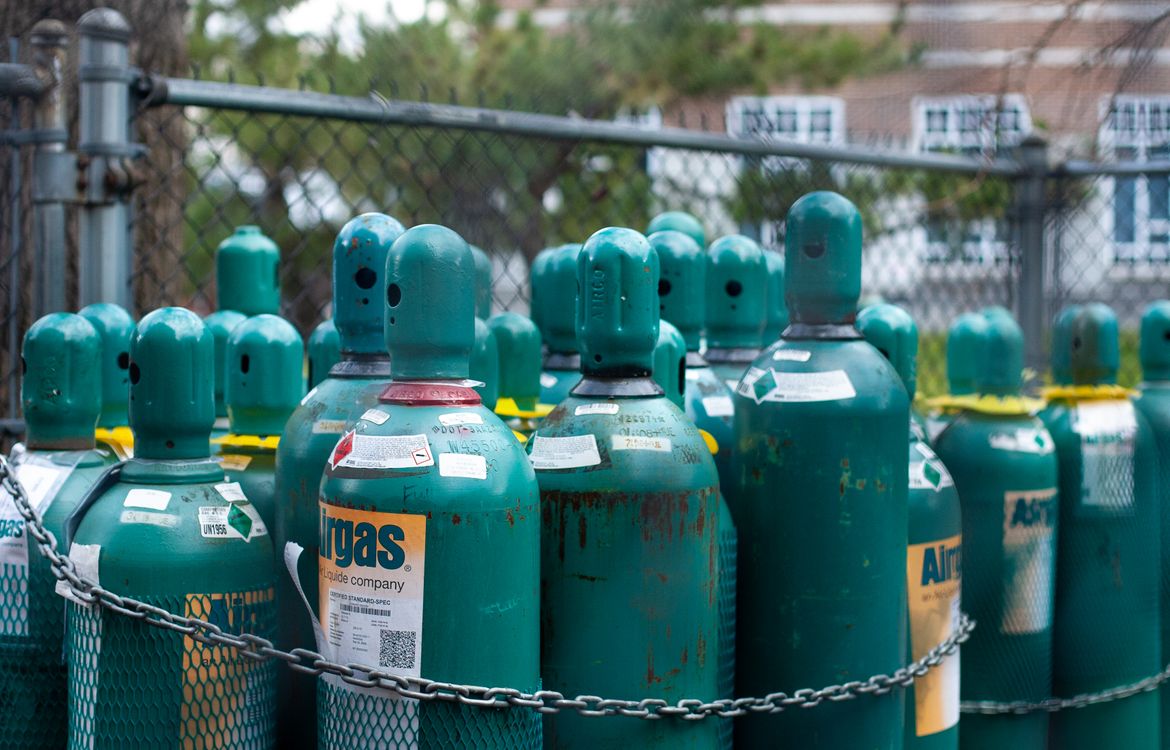
In practice, the two statuses don’t grant the same rights. Recycled gas may only be used by the undertaking that recovered it, or by the one it was recovered for, so it doesn’t circulate freely on the market. Reclaimed gas, by contrast, has to carry the labelling required by Article 12(7). Field feedback is consistent on this point: it’s the labelling condition, not the quality of the fluid, that decides how an inspection goes.
One consequence gets overlooked routinely. Article 8(6) states that recovered gas cannot be used to fill or top up equipment until it has been recycled or reclaimed. Recovering isn’t enough; it has to be processed first.
Leak checks and certification: the correct article numbers
Leak-tightness obligations sit in Article 5, not Article 10 as is sometimes claimed. Checks become mandatory at 5 tonnes of CO2 equivalent of Annex I gas: every 12 months below 50 tonnes, every 6 months from 50 to 500 tonnes, every 3 months above 500 tonnes. Each checking interval is doubled where a leak detection system compliant with Article 6 is fitted, so the checks become less frequent, not more.
For the rest of the framework, the numbering runs: Article 6 for leak detection systems, Article 7 for record-keeping, and Article 10 for the certification and training of individuals and companies. Article 14 covers HFC production quotas for producers, so citing it for technician certification is a common but plain error. The full set of procedures, thresholds and certificate categories is handled in our dedicated guide to EU F-Gas compliance, certification and leak checks.
Vehicles: an old ban, but recharging is still allowed
R-134a left vehicle air conditioning long before F-Gas III arrived. Directive 2006/40/EC has blocked type-approval of new vehicles fitted with a system designed to contain a refrigerant with a GWP above 150 since 1 January 2011 (Article 5(4)), and since 1 January 2017 it has blocked registration and sale of any such new vehicle (Article 5(5)). The scope covers categories M1 and N1 class I.
Here’s the part most timelines leave out entirely: Article 6(2) of that same directive explicitly preserves the recharging of systems fitted to vehicles placed on the market before 2017. Recharging the air conditioning of an older vehicle with R-134a therefore remains lawful across the EU, and will stay lawful as long as supply holds.
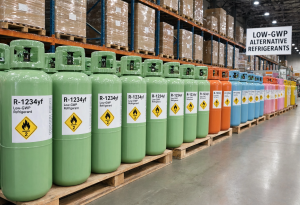
Which alternatives to R-134a, and at exactly what GWP?
Treat published GWP figures carefully, because Regulation (EU) 2024/573 does not use a single basis. Annex I, which lists HFCs such as R-134a, is built on the IPCC Fourth Assessment Report (AR4). Annex II, which lists HFOs such as R-1234yf, is built on the Sixth Assessment Report (AR6). Two refrigerants can therefore be compared on two different reference frames inside the same legal text.
| Refrigerant | GWP | Basis and source | Use |
|---|---|---|---|
| R-134a | 1,430 | AR4, Annex I | Baseline, safety class A1 |
| R-1234yf | 0.501 | AR6, Annex II | HFO, dominant automotive substitute, class A2L |
| R-513A | ≈ 630 | Computed per Annex VI | HFO/HFC blend, class A1, compatible with many components after validation |
| R-290 (propane) | 0.02 | AR6, Annex VI | Natural hydrocarbon, class A3, charge limited on safety grounds |
Picking a substitute is never settled on GWP alone. Moving to an A2L or A3 refrigerant forces a rework of site safety procedures and specific training for the crew, in line with EN 378 and ISO 817, on top of the F-Gas certification requirements attached to those safety classes. Retrofit scenarios on existing industrial plant are worked through in our guide to R-134a alternatives for industrial retrofit.
How do you plan the transition between now and 2032?
The first step isn’t technical, it’s documentary: knowing exactly which units in your estate fall under Article 13(5). The answer turns on two criteria only, equipment type and charge, and it decides whether you have a 2032 deadline or no deadline whatsoever.
- Classify every installation. Stationary refrigeration other than a chiller: caught by the 2032 servicing deadline. Chiller, air conditioning, heat pump: outside the paragraph, no servicing deadline in the text as it stands.
- Record the charge in tonnes of CO2 equivalent. Multiply the charge in kilograms by 1.43 for R-134a. A 35 kg system reaches 50 tonnes CO2 equivalent and moves to six-monthly leak checking.
- Check your leak detection coverage. Above 500 tonnes CO2 equivalent, roughly 350 kg of R-134a, a detection system becomes mandatory, and fitting one doubles each checking interval.
- Identify your reclaimed gas sources. For the units caught by 2032, this is what determines whether they keep running. Recycled gas in a closed loop is only usable by the undertaking that recovered it.
- Decide retrofit or replacement for machines whose remaining service life runs past 2032, costing in the refrigerant, not just the hardware.
One line of reasoning comes up constantly on site: since reclaimed gas stays permitted with no end date, why not simply wait it out? The text does allow it, but it guarantees nothing about volume. Article 13(6) lets the Commission grant temporary derogations of up to four years to a Member State that demonstrates a shortage of reclaimed or recycled refrigerant. That clause wouldn’t be in the regulation if the legislator considered supply a settled matter.
The practical reading is straightforward. Reclaimed gas is an extension strategy, not a permanent status quo. It lets you spread a replacement programme across several budget years instead of absorbing it in one, which is exactly why planning now beats planning in 2031.
One last point deserves attention for equipment that will still be running past 2030. Article 11(1) permits placing spare parts on the market for the repair and servicing of existing equipment listed in Annex IV, provided there is no increase in capacity, no increase in refrigerant quantity, and no switch to a refrigerant with a higher GWP. A like-for-like repair therefore stays possible even after a category has closed to new equipment.
Frequently Asked Questions
Is R-134a banned in 2026?
No. R-134a has a GWP of 1,430, below the 2,500 threshold that triggers the servicing bans in Article 13 of Regulation (EU) 2024/573. It can still be bought and used to service existing installations. Only the placing on the market of certain new equipment is restricted, by category and by date, under Annex IV.
What exactly happens in 2032 for R-134a?
From 1 January 2032, Article 13(5) prohibits the use of Annex I gases with a GWP of 750 or more for servicing stationary refrigeration equipment. This is a servicing restriction, not a ban on placing equipment on the market. R-134a is in scope, but chillers are explicitly excluded, and air conditioning and heat pumps fall outside the paragraph, which reaches stationary refrigeration only.
Can reclaimed R-134a still be used after 2032?
Yes. Points (a) and (b) of Article 13(5) permit reclaimed and recycled gas for servicing existing equipment, with no end date in the text. Reclaimed gas must carry the labelling required by Article 12(7); recycled gas may only be used by the undertaking that recovered it.
Can I still recharge my car air conditioning with R-134a?
Yes, if the vehicle was placed on the market before 1 January 2017. Directive 2006/40/EC has banned R-134a in new vehicles since that date, but its Article 6(2) explicitly preserves the recharging of systems already fitted to earlier vehicles.
What refrigerant replaces R-134a?
R-1234yf (GWP 0.501 under Annex II) dominates automotive use. For stationary applications, R-513A (computed GWP of approximately 630, class A1) often allows a retrofit without changing safety class, while R-290 suits small charges. The choice depends as much on safety class as on GWP.
Conclusion: a transition to plan, not a ban to absorb
R-134a doesn’t disappear in 2032. What changes on that date is which grade of refrigerant may be used for servicing part of the installed base: stationary refrigeration other than chillers has to move to reclaimed or recycled gas. For air conditioning, heat pumps and chillers, no servicing deadline exists in the text today, and nothing in Annex IV stops equipment already in service from being maintained.
The real constraint over the next few years remains availability. The quota tightens, prices follow, and the most heavily charged installations will feel the squeeze first. For the thermodynamic side of the refrigerant itself, see our R-134a properties and PT chart guide. To secure compliant, traceable supply, browse our certified R-134a range.
Disclaimer: the dates and thresholds quoted here come from the text of Regulation (EU) 2024/573 as published in the Official Journal. Delegated or implementing acts may amend the annexes or grant temporary derogations, and national implementing rules vary between Member States. Check the consolidated version in force on EUR-Lex before any investment decision, and have your situation confirmed by a certified professional. Spotted an error on this page? Tell us through our contact page.