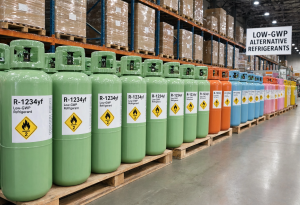
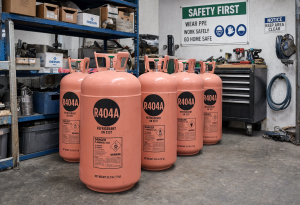
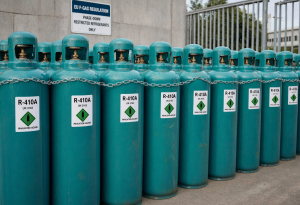
Handling HFC refrigerants without valid F-Gas certification is illegal across the EU, and in some Member States it carries penalties of up to EUR 75,000 and prison time. Certification rules are harmonized EU-wide by Regulation (EU) 2015/2067 (personnel) and (EU) 2015/2068 (companies), while enforcement and penalties are set nationally (EUR-Lex). This guide covers what every refrigeration professional in the EU needs to know: certification categories, leak checks, record-keeping, penalties and available funding.
Key Takeaways
What F-Gas certification does your business need?
Any business handling fluorinated refrigerants in the EU needs two distinct certificates. The company holds an organisation-level certificate under Regulation (EU) 2015/2068, and each technician holds a personal certificate under Regulation (EU) 2015/2067 (EUR-Lex). One without the other is not enough. The personal certificate comes in four categories that define the scope of work a technician may carry out.
A frequent confusion: the company certificate covers the organisation’s right to operate, while the personal certificate proves an individual’s competence. Both are mandatory. Certificates are issued by nationally accredited bodies, which differ by country, but the category definitions are identical across the EU because they come from the same regulation. Picking the wrong category means working outside the legal scope.
| Category | Permitted activities | Typical roles |
|---|---|---|
| I | Leak checking, recovery, installation, maintenance, servicing, repair and decommissioning, any charge size | Refrigeration engineer, AC installer, heat-pump technician |
| II | Same operations, but limited to equipment with < 3 kg charge (< 6 kg if hermetically sealed); leak checks only if no breaking into the circuit | Small-AC technician, light commercial maintenance |
| III | Recovery only, on equipment with < 3 kg charge (< 6 kg hermetically sealed) | Decommissioning operative, WEEE recycler |
| IV | Leak checking only (without breaking into the refrigerant circuit) | Leak-check inspector, inspection body |
How do you obtain or renew certification?
Certificates are issued by accredited certification and evaluation bodies designated by each Member State. In France these include Bureau Veritas, Cemafroid and Socotec; in Germany, bodies accredited under the ChemKlimaschutzV; in Ireland, City & Guilds-aligned assessment centres. The body verifies that your personnel hold valid certificates, that you have compliant tools (recovery unit, calibrated scale, leak detector) and that your procedures are documented.
The process runs in four steps. First, you apply to an accredited body. Second, an assessor reviews your documentation and tools, often with an on-site audit for the company certificate. Third, technicians sit a theory and practical examination for their personal certificate. Fourth, the body issues the certificate. Personal certificates under Reg (EU) 2015/2067 do not expire automatically, but several Member States require periodic refresher assessment, so check your national rules.
What does it cost? Fees vary by country, body and number of sites. Budget roughly EUR 800 to 2,500 for a first company certificate and a few hundred euros per technician for the personal examination. It is an investment, but the alternative, working uncertified, costs far more once an inspection finds you.
From field experience, the most common slip is letting a technician’s certificate lapse where national refresher rules apply. A lapsed technician cannot legally intervene, which can stall an entire job. Build a simple renewal calendar and track every certificate’s status. For the EU regulatory context behind these duties, see our guide to the EU F-Gas Regulation 2024/573.
How does refrigerant traceability and record-keeping work?
Regulation (EU) 2024/573 requires operators to keep records of refrigerant quantities and every intervention for at least 5 years (Art. 7). Recovered refrigerant is classed as hazardous waste and must be handed to certified handlers, then tracked through each Member State’s own system. The EU sets the obligation; the platform differs by country.
In France, this runs through TrackDéchets, where the digital BSFF (refrigerant tracking slip) has been mandatory since 1 January 2023. In Germany, recovered refrigerant moves under the eANV (electronic waste verification procedure) via a certified disposal company (Entsorgungsfachbetrieb). In Ireland and several other states, operators keep equipment logbooks and use registered waste contractors. Whatever the platform, the principle is the same: no refrigerant leaves a site untracked.
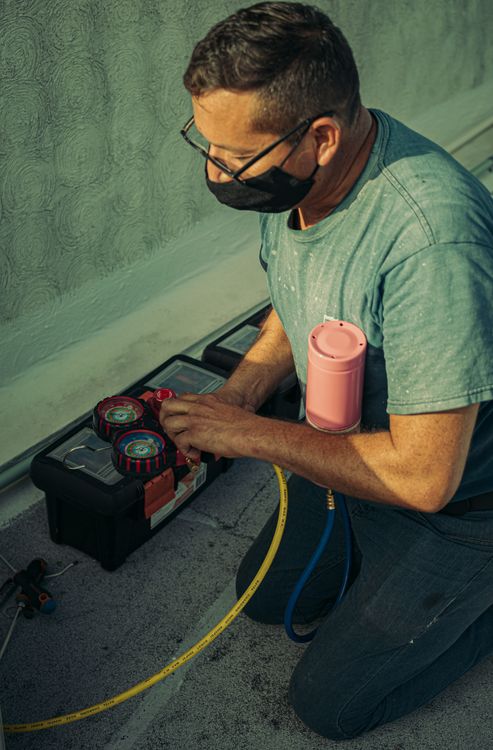
On top of waste tracking, an intervention record must be completed for every job on site. This is the field document the technician fills in during the work: refrigerant type, quantity added or recovered, leak-check result and the equipment’s CO2-equivalent charge. These records feed the national tracking system and are the first thing an inspector asks to see.
How often are leak checks mandatory?
Regulation (EU) 2024/573 (F-Gas III), in force since 11 March 2024, sets leak-check frequency by the equipment’s charge expressed in tonnes of CO2 equivalent, not in kilograms of refrigerant (EUR-Lex). This is a frequent source of confusion. The old system worked in kilograms; the current one works in climate impact.
How do you calculate it? Multiply the charge in kilograms by the refrigerant’s GWP, then divide by 1,000. For example, a system holding 50 kg of R-410A (GWP 2,088) is 50 x 2,088 / 1,000 = 104.4 t CO2eq. That falls in the 50-500 t band: a six-monthly check. The same weight of R-32 (GWP 675) gives 33.75 t CO2eq, so an annual check only.
| Charge (t CO2eq) | Frequency without auto-detection | With leak-detection system | Typical example |
|---|---|---|---|
| 5 to 50 t | Annual | Every 2 years | Office AC (15 kg R-410A = 31 t CO2eq) |
| 50 to 500 t | Every 6 months | Annual | Supermarket pack (50 kg R-410A = 104 t CO2eq) |
| > 500 t | Quarterly | Every 6 months | Industrial plant (300 kg R-404A = 1,177 t CO2eq) |
Equipment above 500 t CO2eq must also have a fixed leak-detection system. After any detected leak, the operator must repair it without undue delay and verify the repair with a follow-up check within one month. For the underlying EU rules, see our EU F-Gas Regulation guide and the HFC phase-down timeline.
What are the penalties for non-compliance?
Regulation (EU) 2024/573 (Art. 31) requires every Member State to set penalties that are effective, proportionate and dissuasive, but the actual amounts and the enforcement authority differ by country. Ignorance of the rules is not a defence anywhere. The table below shows how the framework plays out in two representative markets.
| Member State | Enforcement authority | Penalty framework |
|---|---|---|
| France | DREAL (regional environment authority), customs | Up to EUR 75,000 + 2 years prison for handling without certification (Code de l’environnement R543-122/123) |
| Germany | Länder authorities (Gewerbeaufsicht / Immissionsschutz) | Administrative fines up to EUR 50,000 (ChemKlimaschutzV in conjunction with ChemG) |
| All EU states | National competent authority | Reg (EU) 2024/573 Art. 31: penalties must be effective, proportionate and dissuasive |
A point many overlook: customs authorities also control HFC imports. Since Regulation (EU) 2024/573, import quotas are tighter and shipments without prior authorisation are subject to seizure. This is not only an issue for large importers. A contractor buying refrigerant from a supplier outside the quota system is personally exposed. Check that your supplier is registered before you buy.
What funding supports the switch to low-GWP refrigerants?
Most Member States run funding programmes that help businesses replace high-GWP equipment with low-impact alternatives. In France, the ADEME Fonds Chaleur (EUR 800 million in 2026) backs renewable heating and cooling projects, alongside Energy Savings Certificates (CEE). In Germany, the BAFA Kälte-Klima-Richtlinie funds efficient refrigeration and AC systems using low-GWP refrigerants. Compliance is not only a cost, it can open a funding door.
The economics favour acting sooner. The price of high-GWP virgin gas only climbs as quotas tighten under Regulation (EU) 2024/573, while funding for low-GWP replacements is available now. Stacking a national grant with an efficiency-certificate scheme can cover a meaningful share of a system replacement. The chart below shows why deferring compliance is the expensive option for a typical SME.
For businesses planning to replace R-404A (GWP 3,922) or R-410A (GWP 2,088) systems with low-GWP equipment, the levers stack: a national grant covers part of the investment and an efficiency-certificate scheme reduces the rest. Contact your national energy or environment agency for the programmes open in your country. For the alternatives themselves, see our low-GWP refrigerant guide.
EU F-Gas compliance checklist for businesses
If you have not reviewed your procedures recently, now is the time. Here is the step-by-step path that applies to any EU business, with the national platform noted where it differs.
| Step | Action | Document / platform | Timeframe |
|---|---|---|---|
| 1 | Check your company certificate is valid (Reg (EU) 2015/2068) | Certificate from accredited body | Immediate |
| 2 | Verify each technician’s personal certificate (Reg (EU) 2015/2067, Cat I-IV) | Individual certificate | Immediate |
| 3 | Register with your national refrigerant/waste-tracking system | FR: TrackDéchets · DE: eANV · others: registered waste contractor | 1 day |
| 4 | Inventory all equipment and calculate charge in t CO2eq | Internal register / equipment logbook | 1 week |
| 5 | Schedule leak checks against the t CO2eq thresholds | Calendar + certified operative | 1 week |
| 6 | Keep intervention records for at least 5 years (Art. 7) | Intervention record per job | Ongoing |
| 7 | Confirm tools are compliant and calibrated (recovery unit, scale, detector) | Up-to-date calibration certificates | 1 month |
| 8 | File any national annual reporting on refrigerant quantities | National authority platform (varies by state) | Annual |
Before you start, identify what refrigerant each installation actually holds, since the charge calculation and leak-check schedule depend on it. Our guide on how to find your refrigerant type is the right first step. And if you are unsure whether your R-410A equipment is affected, see is R-410A banned in the EU in 2026?
Frequently Asked Questions
What is the difference between a company certificate and a personal certificate?
The company certificate (Reg (EU) 2015/2068) is issued to the business by an accredited body and covers the organisation’s right to carry out F-Gas work. The personal certificate (Reg (EU) 2015/2067) is held by each individual technician and certifies their competence to handle refrigerants in their category. Both are mandatory across the EU.
How is recovered refrigerant tracked across the EU?
Regulation (EU) 2024/573 requires records of every intervention to be kept for at least 5 years, and recovered refrigerant to be handed to certified handlers. The tracking platform differs by country: France uses TrackDéchets (digital BSFF), Germany uses the eANV electronic waste verification procedure, and other states use equipment logbooks with registered waste contractors.
How do I calculate my system’s charge in tonnes CO2 equivalent?
Multiply the refrigerant charge in kilograms by its GWP (Global Warming Potential), then divide by 1,000. Example: 30 kg of R-410A (GWP 2,088) = 30 x 2,088 / 1,000 = 62.6 t CO2eq. This figure sets your leak-check frequency: annual (5-50 t), every 6 months (50-500 t) or quarterly (over 500 t).
Is R-410A banned in the EU in 2026?
No. R-410A is not banned outright. Regulation (EU) 2024/573 sets restrictions by equipment category against GWP thresholds (Annex IV), not bans by refrigerant name. Servicing existing R-410A systems remains legal, including with virgin gas. See our dedicated article on the status of R-410A for detail.
What funding is available to replace high-GWP equipment?
Most EU states run funding schemes. France offers the ADEME Fonds Chaleur (EUR 800 million in 2026) plus Energy Savings Certificates; Germany offers the BAFA Kälte-Klima-Richtlinie for efficient low-GWP refrigeration and AC. Grants and certificate schemes can often be combined. Contact your national energy or environment agency for open programmes.
Does a homeowner need certification to have their AC serviced?
No. A homeowner does not need a personal certificate. However, the professional they hire must hold a valid company certificate and personal certificate under EU rules. Always check both before engaging a contractor: an uncertified operator exposes you to risk in the event of a leak, and the work itself would be unlawful.
F-Gas compliance is a profitable investment
Becoming F-Gas compliant in the EU is not an abstract burden. It is a structured process with clear steps: hold the right company and personal certificates, train your staff, use your national tracking system, and schedule leak checks in tonnes CO2eq. The cost of compliance is a fraction of the cost of penalties.
For the EU regulatory context, see our full guide to Regulation (EU) 2024/573 and the HFC phase-down timeline 2025-2036. For compliant refrigerant supply, see our range of refrigerants.
Disclaimer: the regulatory information in this article is current as of June 2026 and provided for general guidance only. It is not legal advice. Penalty amounts, thresholds and national procedures may be changed by new instruments. Always consult the official texts on EUR-Lex and your national authority before any contractual or contentious application.