R-410A is not banned outright in the EU. That’s the short answer, and it surprises most contractors who hear it for the first time. HFCs placed on the EU market dropped 37% in 2024 alone (European Environment Agency, 2025), so the assumption that everything high-GWP is already illegal makes sense. But it’s wrong for R-410A.
Regulation (EU) 2024/573 does restrict R-410A, but the restrictions depend on whether you’re installing new equipment or servicing an existing system, and on whether the gas is virgin or recycled. R-410A has a GWP of 1,924 under the IPCC AR5 standard the EU adopted in January 2025 (you’ll still see the older AR4 value of 2,088 in many sources). That figure sits below the 2,500 threshold for the January 2026 servicing ban but well above the 750 cap for new single-split systems. The result? A split reality where R-410A is simultaneously illegal for new installations and perfectly legal for servicing. This guide unpacks what’s allowed, what isn’t, and what your next move should be.
Key Takeaways
Is R-410A Banned in the EU in 2026?
No. R-410A isn’t subject to an outright ban in the EU as of 2026. The EU’s revised F-Gas Regulation (EU) 2024/573 doesn’t ban specific refrigerants by name. It sets GWP ceilings for different equipment categories and use cases (EUR-Lex, Regulation 2024/573). R-410A, with a GWP of 1,924 under the AR5 standard the EU has used since January 2025, falls below the key threshold for servicing but above the limits for most new equipment.
So where does the “R-410A is banned” narrative come from? Mostly from the way the regulation works. It operates on two tracks: equipment-level bans on new products (Annex IV) and servicing restrictions for existing systems (Article 11). R-410A is blocked for new equipment in several categories but remains legal for servicing. That gap between “you can’t install it” and “you can’t service it” is where the confusion starts. The EU is phasing out R-410A through economics and equipment bans, not through one single ban date. For the full regulatory landscape covering all refrigerants and deadlines, our EU F-Gas Regulation 2026 guide covers every milestone from 2025 to 2030.
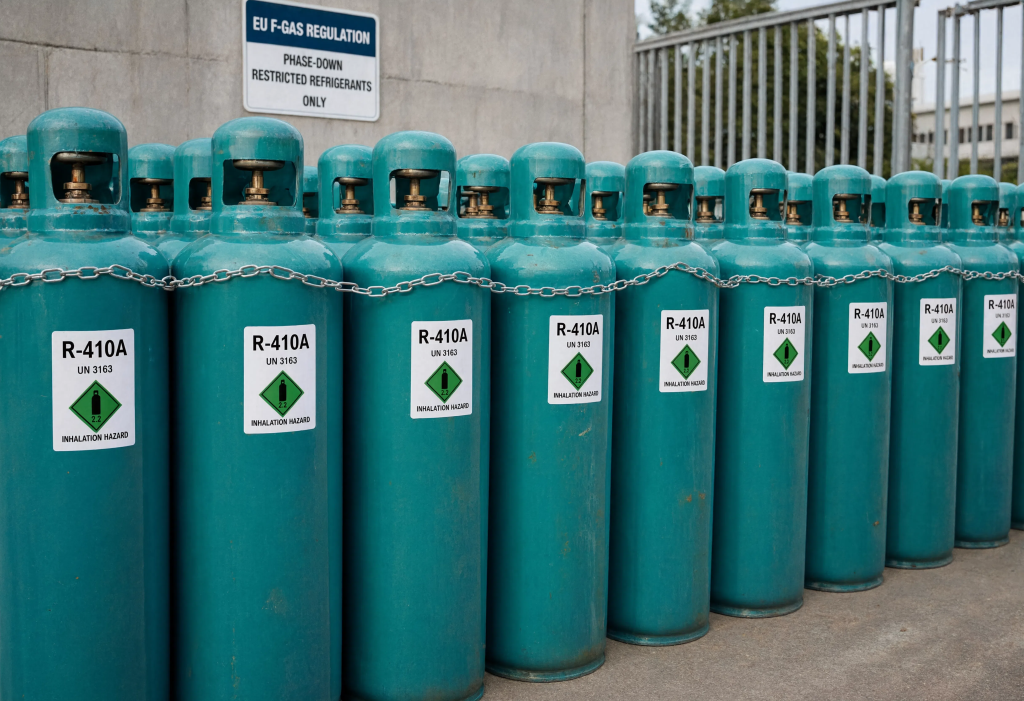
What Are the Rules for New Equipment vs Existing Systems?
New R-410A equipment is banned; servicing existing systems stays legal. That’s the core distinction under Regulation (EU) 2024/573. R-410A fails the GWP threshold for most new equipment categories but passes the servicing threshold comfortably (European Commission, F-gases guidance). Here’s how it breaks down by scenario:
| Scenario | R-410A Status | Effective | Why |
|---|---|---|---|
| New single split AC / HP (<3 kg charge) | ❌ Banned | Jan 2025 | GWP 1,924 exceeds the 750 limit (Annex IV) |
| New split AC ≤12 kW / monobloc | ❌ Banned | Jan 2027 | GWP 1,924 exceeds the 150 limit |
| Servicing existing AC (virgin R-410A) | ✅ Legal | Ongoing | GWP 1,924 is below the 2,500 servicing threshold |
| Servicing existing AC (recycled / reclaimed) | ✅ Legal | No limit | Article 8 exempts recovered gas from all bans |
| Operating installed R-410A equipment | ✅ Legal | No limit | Regulation restricts supply, not installed systems |
The key point from this table: your existing R-410A systems can keep running. Nobody is requiring you to rip them out. The regulation controls what enters the supply chain, not what’s already installed. But can you still get the gas to keep those systems running? That depends on whether you’re buying virgin or recycled.
What’s the Difference Between Virgin and Recycled R-410A Under EU Law?
Virgin R-410A counts against the EU’s shrinking quota; recycled and reclaimed R-410A doesn’t. That’s the distinction that matters most for contractors servicing R-410A systems. Under Regulation (EU) 2024/573, newly produced R-410A eats into the bloc’s shrinking HFC quota. Each kilogram of virgin R-410A consumes 1.924 tonnes of CO₂-equivalent quota, nearly three times as much as R-32 at 0.675 tonnes per kilogram (Regulation 2024/573, Annex VII). Producers allocate their quota to lower-GWP products first because they get more kilograms per unit. R-410A is, put bluntly, the last gas anyone wants to manufacture.
Recycled and reclaimed R-410A operates under entirely different rules. Article 8 of the regulation exempts recovered, recycled, and reclaimed fluorinated gases from both quota allocations and date-based restrictions. If a qualified technician recovers R-410A during system decommissioning and it’s processed to virgin-equivalent purity by a certified reclaimer, that gas can be resold without any GWP limit or ban date. That exemption is the long-term lifeline for the installed R-410A base across Europe. If you’re unsure which refrigerant your existing system uses, our guide to identifying your HVAC refrigerant type walks through the nameplate and cylinder identification process.
How Are R-410A Prices Changing in Europe?
Virgin R-410A trades at EUR 40 to 48 per kilogram for 10 kg cylinders in Europe as of late 2025, prices that are 3.3 to 10.9 times higher than 2014 levels depending on the supply chain position (Öko-Recherche quarterly report for the European Commission, Q4 2025). And from 2026, a new quota fee of EUR 3 per tonne CO₂-eq adds roughly EUR 6 per kilogram to R-410A specifically (Regulation 2024/573, Article 17). The quota itself sits at 31% of the 2015 baseline for 2024 to 2026, drops to 24% for 2027 to 2029, then collapses to 5% from 2030.
Why does R-410A get hit hardest? Because the quota is measured in CO₂-equivalent, not kilograms. One kilogram of R-410A consumes nearly three times more quota than one kilogram of R-32. Importers and producers prioritize lower-GWP products to squeeze more saleable kilograms from their allocation. R-410A production gets cut first. That’s why the day you can’t find affordable virgin R-410A for a top-up won’t be set by a regulation date. It’ll be set by the market. And the market is moving fast.
What Should You Replace R-410A With in the EU?
R-32 is the dominant R-410A replacement in Europe, holding roughly 55% of new split AC and heat pump installations on the continent (Eurovent/EHPA industry estimates, 2025). It clears the 2025 GWP 750 threshold with a GWP of 675, delivers 5 to 8% higher cooling capacity per kilogram than R-410A, and costs significantly less than alternatives. R-32 trades at roughly 25 to 40 EUR per kilogram in the EU, compared to 40 to 60 EUR per kilogram for R-454B. The supply chain is mature, reclamation is straightforward because it’s a single-component refrigerant, and OEMs from Daikin to Mitsubishi Electric to Panasonic all have deep R-32 product lines in Europe.
| Property | R-32 | R-454B | R-290 |
|---|---|---|---|
| GWP (AR5) | 675 | 466 | 3 |
| Safety class | A2L | A2L | A3 |
| EU price range (EUR/kg) | 25 to 40 | 40 to 60 | 5 to 15 |
| EU market share (new installs) | ~55% | ~10% | Growing (38% of HP certs) |
| Best for | Residential splits, light commercial | Carrier/Trane/JCI systems | Self-contained, small heat pumps |
R-454B (GWP 466) fills a narrower niche in Europe, primarily in systems designed by US-heritage manufacturers like Carrier, Trane, and JCI/York. It offers a lower GWP than R-32 but costs more due to the HFO patent component (R-1234yf) and requires blend-separation for reclamation. For a detailed technical comparison, see our complete R-454B refrigerant guide. From what we’ve seen in the EU market, contractors who service mixed fleets are standardizing on R-32 for new residential projects and keeping R-454B knowledge for specific commercial accounts. Neither refrigerant passes the 2027 GWP 150 limit for larger categories, so R-290 (propane, GWP 3) is gaining ground fast: it accounted for 38% of new EU residential heat pump certifications in 2024, up from just 3% in 2021 (Heat Pumps Watch, 2025).

Frequently Asked Questions
Is it illegal to use R-410A in the EU after 2026?
No. Using R-410A to service existing AC systems remains legal. The January 2026 servicing ban under Regulation (EU) 2024/573 only applies to virgin fluorinated gases with GWP of 2,500 or higher. R-410A’s GWP of 1,924 (AR5) falls below that line. Recycled and reclaimed R-410A has no date restriction at all.
Does R-410A have a GWP of 2,088 or 1,924?
Both figures are correct but refer to different IPCC assessment reports. The older AR4 value is 2,088; the newer AR5 value is 1,924. The EU switched to AR5 GWP values in January 2025, so 1,924 is the figure that applies to current regulatory assessments. The regulatory thresholds (2,500, 750, 150) stayed the same.
Will my existing R-410A air conditioner need to be replaced?
No. The EU F-Gas Regulation does not require removing or replacing installed equipment. Your R-410A system can run until its natural end of life. The regulation restricts what can be sold and used for servicing, not what’s already in the field. Plan your replacement around equipment age and service costs, not compliance deadlines.
Can I convert my R-410A system to R-32?
Not as a simple drop-in. R-32 operates at slightly different pressures and is a mildly flammable (A2L) refrigerant, which means the system must be designed for it. Retrofitting an R-410A unit to R-32 isn’t recommended by any major OEM. The practical path is to continue servicing the R-410A system with recycled gas until replacement, then install new R-32 equipment.
Is recycled R-410A as good as virgin gas?
Reclaimed R-410A that has been processed to AHR 700 standard (the internationally recognized purity specification) is functionally equivalent to virgin gas. Recycled gas that has only been cleaned on-site without full reclamation may have lower purity. For system longevity, insist on reclaimed (not just recycled) R-410A from a certified reclaimer.
What happens to R-410A availability after 2030?
The EU HFC quota drops to 5% of the 2015 baseline from 2030, which will make virgin R-410A extremely scarce and expensive. Servicing legacy equipment will rely almost entirely on reclaimed stock. Contractors should start recovering R-410A from every decommissioned system now to build reserves. The 2030 cliff is the practical end of affordable virgin R-410A in Europe.
The Bottom Line
R-410A isn’t banned in the EU. Not yet, and not in the way most people think. You can still service existing systems with virgin gas, and recycled R-410A has no restrictions at all. But the economics tell a different story: every quota cycle makes virgin gas scarcer and more expensive, while alternatives like R-32 and R-454B get cheaper and more widely available. The smart move? Service what you have with reclaimed gas, specify R-32 for every new project, and don’t plan any new R-410A installations. The regulation didn’t ban R-410A outright. The market will.
Looking for EU-standard cylinders of R-32, R-454B, or reclaimed R-410A? The Refrigeration Store ships across the EU within 24 hours.