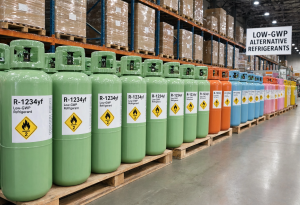
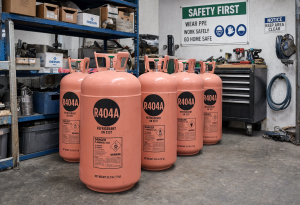
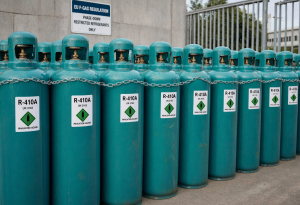
More than 80% of heat pumps sold in Europe in 2019 contained R-410A (BSRIA, 2019). While the new-equipment market shifts to R-32 and R-454B, the installed base stays heavily on R-410A for another ten to fifteen years. This guide is not another article about bans or alternatives. It is a field reference: PT chart, diagnostic parameters, charging procedure and inspection duties for the people working on these systems every day.
Key Takeaways
What is R-410A and why is it still everywhere in 2026?
R-410A is a blend of R-32 (difluoromethane, 50% by mass) and R-125 (pentafluoroethane, 50%). Its GWP is 2,088 on the IPCC AR4 values (Wikipedia, IPCC data). A commonly misunderstood point: R-410A is neither zeotropic nor azeotropic in the strict sense. It is a near-azeotropic blend, with a temperature glide below 0.1 K. In practice it behaves thermodynamically like a pure substance.
Its ASHRAE classification is A1: non-toxic, non-flammable. Critical pressure: 49.0 bar. Critical temperature: 72.8°C. Working pressure roughly 1.6 times that of the old R-22. Not sure which refrigerant is in your system? Our guide to identifying your refrigerant type shows where to find the nameplate. Why still talk about it in 2026? Because despite restrictions on new equipment, servicing existing systems remains legal, including with virgin gas. For the detail of the restriction rules, see our article on the status of R-410A in the EU.
How do you read the R-410A pressure-temperature chart?
At 25°C, the saturation pressure of R-410A reaches 16.5 bar absolute, about 15.5 bar gauge (Engineers Edge, NIST REFPROP data). That is the figure every technician should have in mind when connecting hoses to an outdoor unit at 25°C ambient. If the reading is more than 1.5 bar off the expected value, there is a problem: overcharge, undercharge, partial restriction or a fouled heat exchanger.
| Temperature (°C) | Abs. pressure (bar) | Gauge pressure (bar)* | Usage zone |
|---|---|---|---|
| -20 | 4.00 | 2.99 | Low-temp refrigeration |
| -10 | 5.73 | 4.72 | Low-temp refrigeration |
| 0 | 7.99 | 6.98 | 🔵 AC evaporator |
| 5 | 9.34 | 8.33 | 🔵 AC evaporator |
| 10 | 10.86 | 9.85 | 🔵 AC evaporator |
| 15 | 12.55 | 11.54 | 🔵 Heat-pump evaporator |
| 20 | 14.44 | 13.43 | Intermediate zone |
| 25 | 16.54 | 15.53 | Intermediate zone |
| 30 | 18.85 | 17.84 | 🔴 Condenser |
| 35 | 21.40 | 20.39 | 🔴 Condenser |
| 40 | 24.21 | 23.20 | 🔴 Condenser |
| 45 | 27.28 | 26.27 | 🔴 Condenser |
| 50 | 30.65 | 29.64 | 🔴 Condenser |
How do you use this chart day to day? Measure the outdoor temperature (condenser side) or the supply-air temperature (evaporator side). Look up the expected pressure in the chart. Compare it with your gauge reading. A gap of more than 1 to 2 bar on the high side, or more than 0.5 bar on the low side, signals an anomaly. Simple? Yes. But how many technicians still work without this reflex?
What are the essential diagnostic parameters of an R-410A system?
On a split system with a thermostatic expansion valve (TXV), the target subcooling is 5 to 7 K, and superheat 5 to 8 K (AC Service Tech). On a fixed-orifice (piston) system, superheat is the primary indicator: aim for 5 to 8 K following the manufacturer’s chart, which varies with outdoor dry-bulb and indoor wet-bulb temperature.
How do you do it in practice? Clamp your temperature probes on the liquid line (before the expansion valve) and the suction line (after the evaporator). Read the high-side and low-side pressures. Find the matching saturation temperature in the PT chart above. Subcooling = high-side saturation temperature minus the measured liquid-line temperature. Superheat = measured suction-line temperature minus low-side saturation temperature.
| Symptom | Subcooling | Superheat | Probable cause |
|---|---|---|---|
| Low LP, low HP | High (> 10 K) | High (> 12 K) | Undercharge or restriction |
| High LP, high HP | Low (< 3 K) | Low (< 3 K) | Overcharge |
| Low LP, high HP | High | High | Liquid-side restriction or faulty expansion valve |
| High LP, normal HP | Normal | Low | Liquid floodback to compressor |
A 2 K deviation from the subcooling target warrants investigation. But be careful: before touching the charge, first check the airflow over the evaporator and the cleanliness of the condenser. A clogged filter throws off the entire diagnosis.
How do you charge an R-410A circuit correctly?
R-410A must always be charged in the liquid phase, never as vapour. With vapour charging, R-32 (boiling point -51.7°C) evaporates faster than R-125 (-48.1°C) inside the cylinder, which changes the composition of the blend injected into the circuit (HVAC Toolkit). This is called fractionation. The result: shifted pressures, reduced capacity and potentially a compressor running out of its envelope.
Pink R-410A cylinders have a dip tube for liquid withdrawal. If your cylinder does not, invert it. Here are the key steps:
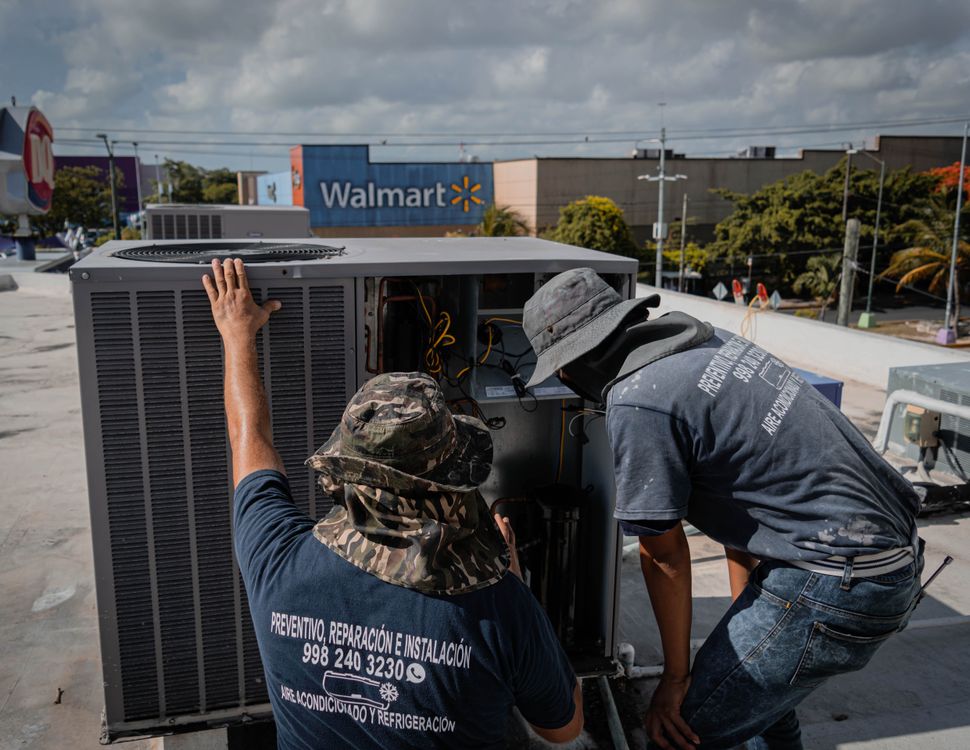
- Recover any residual refrigerant into a dedicated cylinder, never to atmosphere.
- Evacuate the circuit to below 500 microns (67 Pa) for at least 30 minutes. On a new or open circuit, aim for 250 microns.
- Check the vacuum holds: close the pump, wait 10 minutes. If the pressure rises above 750 microns, moisture or a leak remains.
- Charge as liquid through the high-pressure line (system off) or the low-pressure line (system running, with a flow-control valve).
- Weigh the charge on an electronic scale. The exact amount is on the outdoor unit’s nameplate, adjusted for line-set length.
- Check subcooling and superheat after 10 to 15 minutes of stable running.
Which oils and components are specific to R-410A?
The standard oil for R-410A is a polyolester (POE) oil of ISO VG 32 viscosity, such as Emkarate RL 32H. Its water content must not exceed 30 ppm before charging (Emkarate RL 32H, CPI/Lubrizol). This is a point many underestimate: POE is extremely hygroscopic. Leave a container open for thirty minutes and the oil absorbs enough moisture to form acid in the circuit.
What components change versus an old R-22 system? Because working pressures are about 60% higher, copper tubing is thicker (reinforced wall), flare fittings are specific, and service valves rate at least 45 bar. Filter driers must be sized for POE, not mineral oil. And never use mineral oil in an R-410A circuit: it is not miscible with HFCs and causes rapid compressor seizure. On old R-22 systems, some operators choose an R-407F retrofit in commercial refrigeration rather than a full replacement.
For high-capacity compressors (rooftops, VRF), some manufacturers specify a POE VG 56 or even VG 68, such as Bitzer BSE 55. Always check the manufacturer documentation before choosing viscosity. Mixing two POE grades poses no chemical compatibility problem, but it changes the resulting viscosity.
What leak checks does F-Gas require for R-410A?
From 2.4 kg of R-410A in a circuit (5 tonnes CO2 equivalent), Regulation (EU) 2024/573, Article 5, requires periodic leak checks. A 3 kg residential split is already above the threshold. And an office VRF holding 25 kg moves into the six-monthly check band.
| R-410A charge | CO2 equiv. | Without auto-detection | With auto-detection |
|---|---|---|---|
| 2.4 to 24 kg | 5 to 50 t CO2eq | Every 12 months | Every 24 months |
| 24 to 240 kg | 50 to 500 t CO2eq | Every 6 months | Every 12 months |
| More than 240 kg | More than 500 t CO2eq | Every 3 months | Every 6 months |
Who can perform these checks? Any technician holding a valid F-Gas personal certificate, Category I (or Category IV for leak checking only), under Regulation (EU) 2015/2067, issued by a nationally accredited body. Companies must also hold a company certificate (Reg (EU) 2015/2068). For the full picture of certification, record-keeping and penalties, see our EU F-Gas compliance guide, and for the regulatory background our F-Gas Regulation guide.
When should you maintain an R-410A system, and when replace it?
The median service life of a split or air-to-air heat pump is 15 years per ASHRAE (ASHRAE Handbook, HVAC Applications). Past that point, maintenance costs and excess energy use climb faster than the amortisation of new equipment. But 15 years is a median. A well-maintained system can last 20. A neglected one fails in 8.
How do you decide? Three criteria matter more than age alone:
- Recharge frequency: if you add R-410A more than once a year, the leak is structural. Repairing often costs more than replacing on a system of 12 years or older.
- COP gap: measure the actual input power and cooling capacity. If the COP has dropped more than 20% versus the manufacturer data, the compressor is tiring.
- Refrigerant cost: virgin R-410A trades at EUR 15 to 30/kg in 2026. That price will rise as HFC quotas tighten. To track it, see our analysis of R-410A status and pricing in Europe.
For VRF systems or chillers, the analysis differs: replacement cost is far higher, and conversion to R-32 is not a viable option (no manufacturer officially supports it). See our low-GWP refrigerant guide to evaluate alternatives on large installations.
What mistakes should you avoid when working on an R-410A circuit?
From field feedback by distributors and training centres, the same mistakes recur year after year. They cost dearly in burnt-out compressors and warranty callbacks. Here they are, ranked by frequency:
- Charging as vapour instead of liquid. We said it above, but it remains mistake number one. Fractionation shifts the pressures and misleads the diagnosis.
- Using R-22 hoses on an R-410A circuit. R-22 hoses cannot withstand R-410A pressures (45 bar service minimum). Risk of bursting.
- Skimping on evacuation. An insufficient vacuum leaves moisture in the circuit. Moisture + POE = acid formation = copper plating on valves = compressor failure in 12 to 24 months.
- Opening a POE container and leaving it open. The oil absorbs airborne moisture within minutes. Pour, reseal immediately.
- Mixing R-410A and R-22 in the same circuit. The two are not miscible. The result is an unstable blend, erratic pressures and a failed compressor.
- Diagnosing the charge without checking airflow. A clogged filter or failed fan throws off subcooling and superheat readings. Always check airflow first.
One last trap, less technical but just as costly: working without valid F-Gas certification. Penalties are set by each Member State and can be severe (for example, up to EUR 75,000 and two years imprisonment in France; administrative fines up to EUR 50,000 in Germany). For the full certification picture, see our EU F-Gas compliance guide.
Frequently Asked Questions
Should R-410A be charged in liquid or vapour phase?
Always in liquid phase. R-410A is a near-azeotropic blend of R-32 and R-125. Vapour charging causes fractionation: the more volatile component (R-32) leaves the cylinder first, which alters the composition of the blend injected into the circuit. Use the pink cylinder’s dip tube or invert it.
What subcooling should you target on an R-410A split system?
On a system with a thermostatic expansion valve (TXV), aim for a subcooling of 5 to 7 K. A deviation greater than 2 K from this target indicates a problem: overcharge (subcooling too high) or undercharge / restriction (too low). On a fixed orifice, superheat is the primary indicator (5-8 K per the manufacturer chart).
How do you detect an R-410A overcharge?
Three signs converge: an abnormally low subcooling (below 3 K), very low superheat (risk of liquid floodback to the compressor), and both high-side and low-side pressures above the normal PT-chart values. Before venting refrigerant, check that the condenser is not fouled: degraded heat transfer produces the same symptoms.
Can you mix virgin and recovered R-410A?
No. Recovered R-410A may have undergone fractionation or cross-contamination with another refrigerant. Only reclaimed R-410A (processed by a certified centre to restore ARI 700 purity specifications) can be reused, and even then it must not be mixed with virgin gas in the same cylinder. For the rules on virgin and reclaimed gas, see our article on the status of R-410A in the EU.
How often are leak checks mandatory for R-410A?
Regulation (EU) 2024/573 sets the frequency by charge in tonnes CO2 equivalent. For R-410A (GWP 2,088): from 2.4 to 24 kg, annual; from 24 to 240 kg, every 6 months; above 240 kg, quarterly. Fitting an automatic leak-detection system halves these frequencies.
Is R-410A dangerous if it leaks in a confined space?
R-410A is classed A1 (non-flammable, non-toxic). But like any gas heavier than air, it accumulates at floor level and can cause asphyxiation by displacing oxygen in a closed room. EN 378 / ASHRAE 34 set charge limits per room volume and require mechanical ventilation in plant rooms. A fixed leak detector is strongly recommended for any basement or windowless installation.
What to remember
R-410A will stay in your circuits for another ten to fifteen years. You may as well manage it correctly. The non-negotiables: charge as liquid, evacuate properly, keep POE clean and dry, run leak checks within the F-Gas deadlines. The rest is diagnosis: subcooling, superheat, PT chart. Three figures that tell you everything about the state of a circuit.
For regulatory questions (bans, quotas, alternatives), see our dedicated articles: status of R-410A in the EU, low-GWP refrigerant guide, HFC phase-down timeline 2025-2036. And if you need R-410A for your work, check that your certification is current before ordering.
Disclaimer: the technical values quoted (pressures, temperatures, costs) are indicative and may vary by manufacturer, equipment model and installation conditions. Always consult the manufacturer documentation. Regulatory information is current as of June 2026 and applies to EU law.