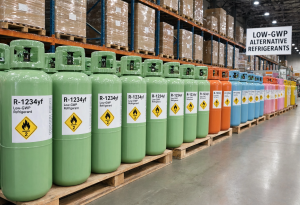
A “low-GWP refrigerant” in 2026 is any working fluid with a Global Warming Potential below the ceiling the EU F-Gas Regulation (EU) 2024/573 sets for its equipment category (European Commission, F-gas legislation). That ceiling isn’t one number. It’s tiered: GWP 2,500 is the outer limit for stationary refrigeration, 750 applies to new single-split air conditioners, and 150 is the bar for self-contained commercial refrigeration and, from 2029, most residential AC. The compliant options split across very different chemistries: A2L blends like R-454B and R-32 for stationary AC, hydrocarbon R-290 for self-contained commercial coolers, R-744 (CO₂) for supermarket transcritical, and R-717 (ammonia) for industrial cold storage. This guide walks through every refrigerant the 2024/573 rules let you specify, when each one wins, and what the codes around them require.
Key Takeaways
- R-32 (GWP 675) is the dominant refrigerant for new residential air conditioners and heat pumps across Europe, with Daikin alone having installed over 280 million R-32 units worldwide since 2012 (Daikin, 2024).
- Regulation (EU) 2024/573 bans new single-split AC with a charge under 3 kg if the refrigerant GWP is 750 or higher (since 2025), and takes all split systems up to 12 kW below GWP 150 from 2029.
- R-290 (propane, GWP 3) charge limits rose from 150 g to 500 g under EN IEC 60335-2-89:2022, opening up most reach-in and display-case categories.
- R-744 (CO₂, GWP 1) sits behind more than 50,000 European supermarket transcritical systems as of end-2025 and is the standard for new retail food refrigeration.
- R-717 (ammonia, GWP 0) runs most of Europe’s industrial refrigeration capacity. As a non-F-gas, it sits entirely outside the F-Gas Regulation’s quota and equipment bans.
What Counts as a “Low-GWP” Refrigerant in 2026?
Under Regulation (EU) 2024/573, “low-GWP” is not a single threshold. It’s a set of equipment-specific caps published in Annex IV. New single-split air conditioners need a refrigerant below GWP 750. Self-contained commercial refrigeration and most new residential AC from 2029 need below GWP 150. Stationary refrigeration carries an outer ceiling of GWP 2,500. So “low-GWP” always means low relative to a sector. The same R-454B that’s compliant in a heat pump is too high-GWP for a new supermarket multipack rack.
The EU’s tiered GWP thresholds, explained
GWP measures how much heat a refrigerant traps over 100 years compared to an equal mass of CO₂. R-410A’s GWP of 1,924 means one kilogram of leaked R-410A traps as much heat as 1,924 kg of CO₂. The EU’s tiered ceilings were chosen deliberately. The 750 cap on single-split AC clears the common A2L options (R-454B at 466, R-32 at 675) while excluding the legacy blend R-410A. The 150 cap, which reaches residential splits in 2029, eventually excludes R-32 too and points the market toward propane and CO₂.
Which GWP numbers apply: AR4 or AR5?
The EU F-Gas Regulation switched its GWP reference from the IPCC Fourth Assessment Report (AR4) to the Fifth (AR5) on 1 January 2025. Under AR5, R-410A is rated 1,924, down from 2,088 in AR4. R-32 stays at 675, and R-454B sits at about 466. ASHRAE Standard 34 and many international datasheets still quote AR4 figures, so a spec sheet sourced globally may show both. For any EU F-Gas reporting or quota calculation in 2026, AR5 is the number that counts. If you spec equipment for multiple markets, your sheet needs both.
The 2026 EU F-Gas Rules in Plain English
The EU F-Gas Regulation (EU) 2024/573, the third-generation F-Gas Regulation, replaced Regulation 517/2014 and entered into application on 11 March 2024 (EUR-Lex, Regulation (EU) 2024/573). It works through three mechanisms: a steep HFC quota phase-down that caps how much refrigerant can enter the EU market (Annex VII), placing-on-market bans that prohibit specific high-GWP equipment (Annex IV), and containment rules covering leak checks, record-keeping, recovery, and technician certification. The deadlines that matter cluster around 2025 through 2029.
The Annex IV equipment bans
Annex IV names equipment categories and dates. For air conditioning: single-split systems with a charge under 3 kg can’t use a refrigerant of GWP 750 or higher (since 1 January 2025); self-contained AC and heat pumps up to 12 kW must be below GWP 150 from 2027; all split systems up to 12 kW must clear GWP 150 from 2029. For refrigeration, several bans carried over from Regulation 517/2014: self-contained commercial refrigeration has been capped at GWP 150 since 2022, supermarket multipack systems of 40 kW or more since 2022 (with a GWP-under-1,500 allowance for the primary circuit of cascade systems), and stationary refrigeration at GWP 2,500. Existing equipment can keep running. You can still service an R-410A system.
The HFC quota phase-down
The quota is the squeeze that drives prices. Annex VII cut the EU’s permitted HFC supply to roughly 42.9 million tonnes of CO₂-equivalent for 2025-2026, about 48% below the 2023 reference level, then to around 21.7 Mt for 2027-2029 and roughly 9 Mt for 2030-2032 (Danfoss, 2024). The 2027 step is the cliff. Refrigerants that were merely expensive in 2025 become genuinely scarce as allowances tighten. Production is on its own track, falling toward 15% of the historic baseline by 2036.
Leak checks, records, and F-Gas certification
The containment rules tightened too. Equipment holding 5 tonnes of CO₂-equivalent or more must be leak-checked at set intervals, with the frequency rising at the 50 and 500 tonne CO₂e marks, and halving where a fixed leak-detection system is fitted. Operators must keep records, recover refrigerant at end of life, and use technicians and companies certified under Commission Implementing Regulation (EU) 2015/2067. New for 2026: a statutory quota allocation fee of €3 per tonne of CO₂-equivalent under Article 17 of the regulation.
A2L Refrigerants: R-32 and R-454B
The two A2L refrigerants doing the heavy lifting in residential and light commercial AC are R-32 (GWP 675) and R-454B (GWP 466). In Europe, R-32 is the clear default, used by Daikin, Mitsubishi Electric, and Panasonic across split AC and heat pumps. R-454B leads in North America and shows up in some EU light commercial lines. Both are mildly flammable, both need A2L-rated tools, and both clear the 750 cap. The picking criteria come down to OEM platform and equipment category, not a free choice of gas.
R-32: the European default
R-32 (difluoromethane) is a single-component refrigerant, so there’s zero temperature glide. Its GWP of 675 sits under the 750 cap for new single-split AC. Daikin pushed R-32 globally from 2012 and now ships it across most of its mini-split, monobloc, and air-to-water heat pump lines; Mitsubishi Electric and Panasonic followed. The capacity advantage is real, roughly 5-8% higher cooling per kilogram than R-454B, which matters in heat pumps. R-32’s one catch is the 2029 horizon: at 675 it sits above the GWP 150 cap that reaches residential splits, so it’s a strong choice now but not a permanent one.
R-454B at a glance
R-454B is a zeotropic blend of 68.9% R-32 and 31.1% R-1234yf with a GWP of 466 and a small temperature glide of around 1 °C. North American OEMs standardized on it for the extra GWP cushion under tighter caps and a lower flammability margin than pure R-32. In the EU service market it’s less common than R-32, but you’ll meet it on imported equipment. For the full deep-dive on properties, manufacturer adoption, pricing, and safety practices, see our companion guide: What Is R-454B Refrigerant? The Complete 2026 Guide. For the regulation behind the AC transition, see our EU F-Gas Regulation 2026 guide.
Natural Refrigerants: R-290, R-744, and R-717
Natural refrigerants (R-290 propane, R-744 carbon dioxide, R-717 ammonia) have GWPs at or below 3 and aren’t F-gases, so they sit entirely outside the F-Gas Regulation’s quota and equipment bans. That makes them future-proof in a way A2Ls aren’t. The trade-off is that each carries a different complication: R-290 is highly flammable, R-744 runs at extreme pressures, and R-717 is toxic at low concentrations. Each owns the application that matches its strengths.
R-290 (propane): self-contained commercial
R-290 is propane purified to refrigerant grade, with a GWP of 3 and an A3 (highly flammable) safety classification. Charge limits used to cap it at 150 grams, which only covered ice machines and very small reach-ins. Then the IEC raised the limit to 500 grams, ratified into the European harmonized standard EN IEC 60335-2-89:2022 (Epta Refrigeration, 2022). That single rule change opened up most reach-in coolers, freezers, vending machines, and beverage merchandisers to R-290 designs. The systems must be hermetically sealed, brazed joints only with no flares, and they’re always self-contained, with no field-installed line sets.
R-744 (CO₂): supermarket transcritical
R-744 is the dominant refrigerant for new supermarket and convenience-store refrigeration across Europe. By the end of 2025 over 50,000 transcritical CO₂ systems were running in European retail, including Carrefour, Tesco, ALDI, and Lidl chains. The numbers are unforgiving: a critical pressure of 74 bar, evaporator pressure around 35 bar, and gas-cooler pressure up to 100 bar in transcritical mode. That requires reinforced pipework, multi-stage compressors, and ejector technology. Danfoss multi-ejector modules raise system COP by 15-25% and have made transcritical viable in hot-climate markets that used to be off-limits.
R-717 (ammonia): industrial cold storage
Ammonia refrigeration runs most of Europe’s industrial refrigeration capacity, cold storage warehouses, food processing, ice rinks, and large-scale chillers, and that share isn’t about to shift. R-717 has a GWP of 0, an ODP of 0, and excellent thermodynamic performance, with no F-Gas quota exposure at all. The catch is its B2L safety classification: it’s toxic above 25 ppm and mildly flammable at very high concentrations. EN 378 governs the design, installation, and operation of the refrigerating system, while the Pressure Equipment Directive (2014/68/EU) covers the pressure vessels. For large inventories, the Seveso III Directive (2012/18/EU) brings major-accident-hazard obligations once ammonia on site passes 50 tonnes.
Where ammonia loses some ground in 2026 is in mid-size plants, roughly 0.5 to 5 tonnes of charge. EN 378’s machine-room ventilation and charge-limit rules have tightened, and several insurers across Europe have started flagging smaller ammonia plants for higher premiums. The trend has pushed designers toward NH₃/CO₂ cascade systems, which keep the high-side ammonia charge small and use CO₂ for the low-side circuits that touch the actual cold space. Cascade designs add complexity and capital cost but cut the ammonia inventory enough to ease the EN 378 machine-room and Seveso obligations.
Transitional HFC Blends: R-448A, R-449A, R-452A
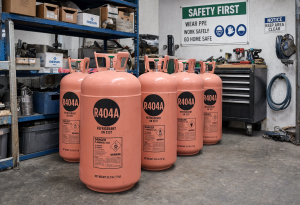
R-448A (Solstice N40) and R-449A (Opteon XP40) are HFO/HFC blends with GWPs of 1,273 and 1,397 respectively. Both are A1 (non-flammable), and both were designed to replace R-404A (GWP 3,922) in food retail. Under EU rules they can’t go into new supermarket multipack systems, the GWP 150 cap there has applied since 2022, but they remain a legal route for retrofitting existing R-404A racks. That matters because virgin R-404A has been banned for servicing since January 2025 under the GWP 2,500 service ban. R-448A is 26% R-32, 26% R-125, 21% R-134a, 20% R-1234yf, and 7% R-1234ze(E); R-449A is a similar blend with slightly different ratios.
Should you specify them in 2026? Not for new systems. For retrofits of existing R-404A equipment, where switching to transcritical CO₂ would mean replacing the entire mechanical room, the math sometimes still favours a transitional blend. Run the numbers carefully against the equipment’s remaining life. Our R-404A 2026 guide covers the service ban and retrofit routes in detail.
Application-by-Application Refrigerant Selection
From what we’ve seen across new equipment specs in early 2026, refrigerant choice has gotten almost deterministic. Each application now has a clear default, with one or two backup options. The matrix below summarizes the picks we’d recommend for new projects, weighted by GWP cap compliance, equipment availability, and total cost of ownership over a 15-year life.
A few selection patterns worth calling out. Across Europe, R-32 is the default for residential AC, heat pumps, and VRF, with R-454B as the alternate on imported equipment. Self-contained commercial cooler manufacturers have aggressively converted from R-404A to R-290 because the 500-gram limit covers most of their model line. New supermarket builds skip transitional HFC blends entirely and go straight to transcritical CO₂. Mobile AC has its own ecosystem (R-1234yf since the EU MAC Directive) and isn’t part of the stationary HVAC&R conversation in any meaningful way.
Costs and Tooling Reality
The 2026 transition isn’t free, and the quota is the reason. By late 2025, R-410A traded at roughly 3.3 times its 2014 end-user price, and as much as 10.9 times higher at distributor level (Cooling Post, 2026). F-gas quota authorisations changed hands at €12-20 per tonne of CO₂-equivalent, averaging about €16. R-32 prices actually eased around 6% in late 2025 as supply settled, but the long trend is up. Natural refrigerants escape that pressure, but push cost into equipment: a transcritical CO₂ rack runs roughly 15-25% more than an HFC equivalent.
The EU HFC quota squeeze
What about tools? Most contractors need three additions to the van: an A2L-rated leak detector (NDIR infrared is the field standard), a recovery machine listed for A2L (class 2L) service under EN IEC 60335-2-40, and a digital manifold with R-32 and R-454B profiles loaded. Brushless vacuum pumps were already common; now they’re effectively required. For shops moving into CO₂ work, the tooling delta is much bigger and includes recovery cylinders rated to about 124 bar, oil-free vacuum pumps, and leak detection sensitive to CO₂ at low ambient concentration. Not sure which refrigerant a system already holds? Our guide on how to find your HVAC refrigerant type walks through it.
Safety Codes for A2L and A3 Refrigerants
The shift to lower-GWP refrigerants has driven a wave of code updates because flammability and pressure profiles changed. EN 378 is the overarching European safety standard for refrigerating systems and heat pumps, covering charge limits by safety class and occupied-space category. EN IEC 60335-2-40 is the product standard for A2L residential and light commercial AC and heat pumps. EN IEC 60335-2-89 covers self-contained commercial refrigeration with A3 refrigerants like R-290. National building and installation codes adopt these standards by reference.
Charge limits and refrigerant detection systems
- R-32 / R-454B (A2L) in residential AC: charge limits depend on conditioned space volume and equipment type; refrigerant detection systems are mandatory for indoor units above the calculated threshold under EN IEC 60335-2-40.
- R-290 (A3) in self-contained commercial: 500 g maximum per circuit, hermetically sealed, no flares, with electrical components rated for the application.
- R-744 (A1): no flammability charge limits, but the ~124 bar design pressure drives almost every engineering decision.
- R-717 (B2L): large ammonia inventories trigger Seveso III major-accident obligations at 50 tonnes. Toxicity-driven machine-room ventilation rules apply under EN 378.
One thing we keep telling new customers: the safety code framework isn’t optional and it isn’t paperwork. An A2L installation that skips the detection sensor or uses non-spark-proof relays passes inspection by accident, then fails its first leak event. Same with R-290 reach-ins shipped with field-flared connections instead of brazed joints, which voids the product certification on the spot.
What’s Next After 2026: The Sub-150 GWP Horizon
Don’t get too comfortable with today’s caps. The next regulatory steps land hard: from 2027 self-contained AC up to 12 kW must clear GWP 150, from 2029 all residential splits must too, and the HFC quota drops from 42.9 Mt to roughly 21.7 Mt for 2027-2029. The combination is going to push more applications toward natural refrigerants and toward a new generation of HFOs and HCFOs starting to reach the market. If you’re spec-ing equipment with a 15-year service life today, it pays to understand what’s coming.
Next-generation HFOs and HCFOs
Three candidate refrigerants sit in the pipeline for sub-150 GWP applications: R-471A (a Honeywell HFO blend with a GWP under 150 targeting commercial AC), R-1224yd(Z) (a Chemours HCFO with a GWP of 1, used in centrifugal chillers), and R-1233zd(E) (also a Chemours HCFO with GWP 1, common in low-pressure chillers and ORC systems). HCFOs carry a small atmospheric chlorine penalty but degrade quickly in the troposphere, so their effective ODP is essentially zero. Expect them to fill niches that A2Ls and natural refrigerants don’t address cleanly, particularly large building chillers and process heat pumps.
The 2030 quota cliff and beyond
The quota doesn’t stop in 2029. For 2030-2032 the EU’s permitted HFC supply falls again to roughly 9 Mt CO₂-equivalent, and production allowances drop toward 15% of the historic baseline by 2036. The regulation sets a course toward a near-total HFC phase-out, with the Commission due to assess feasibility around 2040. The practical read for anyone specifying equipment now: any system still relying on a mid-GWP HFC in the early 2030s will be running on an expensive, shrinking gas supply long before any outright ban arrives.
Planning your spec for the 2030s
Three rules of thumb we’d offer for new builds in 2026. First, when natural refrigerants are technically feasible (small-charge self-contained, supermarket centralized, industrial cold storage), pick them. They’re permanently exempt from quota pricing pressure. Second, when an A2L is the only option, match it to the OEM platform you’re buying; in Europe that usually means R-32, and don’t expect it to survive the 2029 GWP 150 step in residential splits. Third, avoid transitional HFC blends (R-448A, R-449A) for new equipment unless the alternative is keeping an R-404A system limping along. The bridge blends will be expensive long before they’re banned.
Frequently Asked Questions
What’s the lowest-GWP refrigerant available in 2026?
R-744 (carbon dioxide) and R-717 (ammonia) are the lowest, with GWPs of 1 and 0 respectively. R-290 (propane) is close behind at 3, and R-1234yf (used in automotive AC) sits at 4. None of these are F-gases, so none fall under the EU F-Gas quota or its equipment bans. They’re future-proof against any plausible future tightening of GWP caps, but each has handling complications that limit it to specific applications.
What is an A2L refrigerant?
A2L is the safety classification for refrigerants with lower toxicity (Class A) and lower flammability (2L). They have a burning velocity below 10 cm/second and an LFL of at least 3.5% by volume. R-32 and R-454B are the dominant A2L refrigerants in 2026 stationary AC across Europe. Mildly flammable, but far less ignitable than propane (A3) or natural gas, and handled safely under EN 378 and EN IEC 60335-2-40.
What F-Gas containment and certification rules apply in 2026?
Regulation (EU) 2024/573 requires leak checks on equipment holding 5 tonnes of CO₂-equivalent or more, with frequency rising at the 50 and 500 tonne marks. Operators must keep records and recover refrigerant at end of life. Anyone handling F-gases, and the companies employing them, must hold certification under Commission Implementing Regulation (EU) 2015/2067. A €3 per tonne CO₂e quota allocation fee also applies from 2026.
What are the best commercial HVAC refrigerant options for 2026?
It depends on the application. Light commercial AC and heat pumps default to R-32, with R-454B as an alternate. New supermarket centralized refrigeration goes to transcritical R-744 (CO₂) to clear the GWP 150 cap. Self-contained commercial coolers convert to R-290. Cold storage warehouses and industrial process refrigeration stay on R-717 ammonia. R-448A and R-449A serve only as bridge blends for retrofitting existing R-404A systems.
Why is R-290 propane refrigerant safe in commercial coolers?
R-290 is highly flammable, but charge limits keep total fuel inventory below the level needed to create a hazardous indoor concentration even after a full release. The EN IEC 60335-2-89:2022 cap of 500 grams per circuit, combined with hermetic sealing, spark-proof electrical components, and ventilated enclosures, has produced a strong safety record across hundreds of thousands of installed self-contained units in Europe.
Can I still buy and service R-410A equipment after 2026?
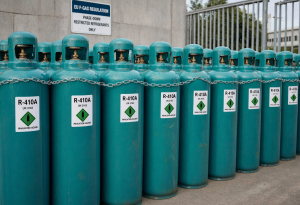
You can service it, but you can’t buy most new R-410A AC. New single-split systems with a charge under 3 kg have been barred from using GWP 750-plus refrigerants since 2025, which rules out R-410A. Existing R-410A systems are unaffected: at GWP 1,924 (AR5), R-410A sits below the 2,500 service-ban threshold, so it can still be topped up and repaired with reclaimed gas. Replacement equipment, though, will be R-32.
What’s the difference between transcritical and subcritical CO₂ refrigeration?
Subcritical CO₂ stays below the 74 bar critical point and behaves like a conventional refrigerant. Transcritical operates above the critical pressure on the high side, which is what most modern supermarket racks do because it allows compact gas coolers and heat reclaim. Transcritical is harder to design and runs at gas-cooler pressures up to 100 bar, but it scales better and works in warmer climates with multi-ejector technology.
When are R-410A and R-32 banned in new EU air conditioners?
R-410A (GWP 1,924) is already out of new single-split AC with a charge under 3 kg, banned since 1 January 2025 under the GWP 750 cap. R-32 (GWP 675) clears that cap and remains the standard now, but it’s banned from all new split systems up to 12 kW from 1 January 2029 under the GWP 150 cap. Larger VRF and multi-split systems above 12 kW follow, with a GWP 150 ban from 2033.
The Bottom Line on Low-GWP Refrigerants in 2026
The 2026 refrigerant landscape isn’t one transition. It’s six. Residential and light commercial AC are A2L territory now, and in Europe that means R-32. Self-contained commercial coolers belong to R-290. Supermarket refrigeration is moving wholesale to transcritical CO₂. Cold storage stays with ammonia. Industrial process keeps ammonia or moves to CO₂ cascade. Automotive has been on R-1234yf for years already. Pick the refrigerant that matches the application, plan the tooling and code work around the safety class, and don’t try to make one fluid serve every use case. That era ended with R-410A.
Need cylinders, A2L-rated tools, or sourcing for natural refrigerants? The Refrigeration Store stocks R-454B, R-32, R-290, R-448A, and R-449A in EU-standard cylinders, with delivery across the EU.