Written by the Refrigeration Team, specialists in refrigerant gases and European F-Gas compliance. Last updated: 17 September 2026.
Can you put R32 in place of R410A? No, and the reason usually given is wrong. At 35 °C, R32 reads 21.90 bar absolute against 21.40 bar for R410A (CoolProp calculation, NIST reference equations). It doesn’t run at lower pressure; it runs slightly higher. What actually rules out conversion is discharge temperature, the A2L safety class and the way the unit was certified.
Key Takeaways
Can you replace R410A with R32 in an existing system?
No. We found no manufacturer that approves this swap, and compressor maker Copeland is blunt about it: don’t charge an R410A system with an A2L refrigerant, and R410A compressors or components are incompatible with an A2L-optimised system, and vice versa. An R410A unit is kept, repaired or replaced by a new unit designed for its own refrigerant.
The confusion starts from a real fact: R410A is already 50% R32. So it’s tempting to treat pure R32 as a “simplified” version of the same gas. It isn’t. Taking R125 out of the blend raises the discharge temperature and moves the refrigerant from safety class A1 to A2L. The unit itself was sized and certified for the blend.
Looking for the diagnostic procedure or the full R410A pressure-temperature table? You’ll find both in our R410A PT chart and diagnostics guide. This article focuses on what sets the two refrigerants apart.
R32 vs R410A: which technical differences really matter?
Of seven properties, only two change the picture for an existing unit: discharge temperature and safety class. The values below come from reference equations of state (CoolProp 8.0) and, for GWP, from Annexes I and VI of Regulation (EU) 2024/573. Saturation pressure is very close, R32’s critical point is higher and its GWP is about a third of R410A’s.
| Property | R410A | R32 | What it means |
|---|---|---|---|
| Composition | R32 50% + R125 50% | Pure difluoromethane | Quasi-azeotropic blend (glide about 0.1 K) vs a pure substance |
| GWP (Regulation 2024/573) | 2,088 | 675 | Annex I (IPCC AR4 basis), Annex VI weighted average for the blend |
| Safety class (ISO 817) | A1 | A2L | Different charge and location limits (EN 378, EN IEC 60335-2-40) |
| Saturation pressure at 35 °C | 21.40 bar abs | 21.90 bar abs | 2.3% difference, no practical effect in the normal operating range |
| Discharge (evap. 5 °C, cond. 45 °C, isentropic) | 67 °C | 80 °C | +13 K in theory, about +20 K according to Siam Compressor: the gap that counts |
| Critical point | 71.3 °C / 49.0 bar | 78.1 °C / 57.8 bar | More headroom below the critical point for R32 |
| Refrigerating effect per kg* | 163 kJ/kg | 247 kJ/kg | About one third less mass flow for the same capacity |
Pressure: a non-issue
You’ll often read that R32 works at lower pressure than R410A. It’s the other way round, and only just. R32 is the more volatile component of the blend: on its own, it gives a slightly higher pressure, from 1.8% at 0 °C up to 2.5% at 50 °C. The chart below shows how closely the two curves overlap.
In practice, then, pipework pressure rating isn’t what rules out conversion. But this closeness makes mistakes easy. A gauge can’t tell you whether a circuit holds R32 or R410A. Only the rating plate settles it, and our guide on how to identify your system’s refrigerant explains where to find it.
Discharge temperature: the real obstacle
Under the same conditions, R32 leaves the compressor noticeably hotter. Our isentropic calculation gives 80 °C against 67 °C, a 13 K gap. Tests by Siam Compressor Industry presented at Purdue in 2016 report a discharge temperature about 20 K higher and note that this heat can damage the compressor motor at high compression ratios.
Units designed for R32 compensate with dedicated controls: discharge superheat control and electronic limits on the compression ratio. The same authors only consider R32 suitable for heat pumps when discharge superheat is controlled. An R410A unit was never calibrated for these temperatures. Its protection thresholds and control logic were set for the blend, not for R32.
A2L flammability changes the installation rules
R410A is classed A1 and R32 A2L, meaning mildly flammable with a low burning velocity. That’s more than a line on a data sheet. It triggers the charge limits per room volume in EN 378 and the requirements of the product standard EN IEC 60335-2-40: electrical parts that can’t act as ignition sources, plus leak detection or ventilation depending on the charge.
An R410A air conditioner was never assessed against these criteria. There’s no reason why the relays, terminal block or indoor fan should be suitable for use with a flammable refrigerant. Putting R32 into it means operating a product outside the scope of its declaration of conformity.
Oil and charge: why the settings don’t carry over
Both refrigerants run with synthetic oils, but the compressor manufacturer picks the formulation and viscosity grade based on the discharge temperature. The right oil is the one specified by the maker of the installed compressor, not a “generic R32” oil. Mixing two oils in one circuit adds a degradation risk that nothing justifies.
The charge doesn’t carry over either. R32’s refrigerating effect reaches 247 kJ/kg against 163 kJ/kg for R410A under our calculation conditions, so for the same capacity the mass flow drops by about one third. The expansion valve, capillary and refrigerant quantity were all matched to R410A. No simple rule of proportion gets you from one to the other.
Why should you never top up R410A with R32?
Because what’s left in the circuit is no longer R410A. R410A is defined by its 50/50 composition. Add R32 and you shift the proportions, and with them the pressure-temperature curve, the discharge temperature and the safety class of the contents. Every manufacturer setting becomes wrong, and your gauges won’t warn you, since the pressures stay so close.
The temptation exists precisely because R410A already contains R32. The result is worse than the original leak. The mixture can no longer be reclaimed as R410A: you have to recover all of it, send it to a treatment facility, pull a vacuum and recharge with virgin or reclaimed R410A. The “cheap” top-up ends up costing a full charge.
What would an R410A to R32 “conversion” really cost?
Far more than a change of gas. To run an R410A circuit on R32 under conditions you could defend, you’d need to replace almost everything that governs how the refrigerant behaves and how safe the unit is:
- The compressor, for a model designed for R32 and its discharge temperature.
- The expansion device and, in most cases, the control board, for discharge superheat control.
- The filter drier and the oil, with a flush of the circuit.
- Any electrical components that could produce a spark, to meet EN IEC 60335-2-40.
- Labelling and documentation, followed by a check of the charge against the EN 378 limits for the room volume.
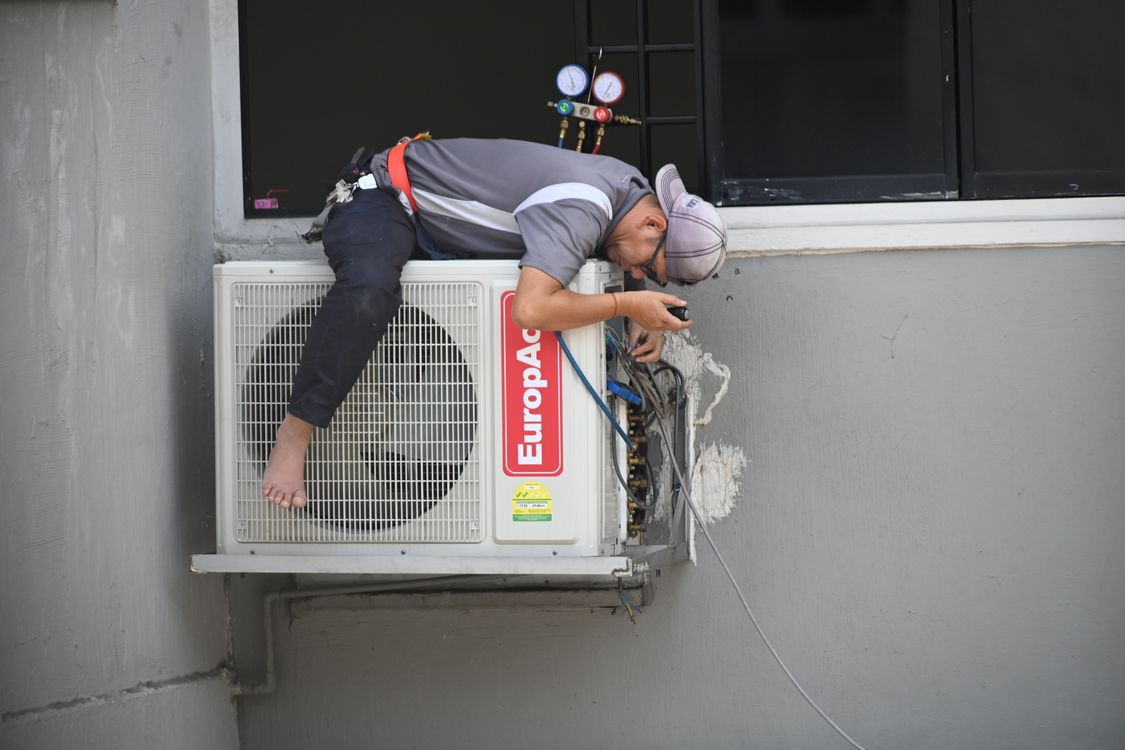
By the end of that list, what’s left of the original unit is the casing, the heat exchangers and the connecting pipework. No manufacturer covers that build, and whoever modifies the unit this way carries the liability alone. For the price of a compressor, a board and the labour, a new unit designed from the start for a permitted refrigerant is almost always the better choice.
That leaves the claim of an efficiency gain of “10% or more”, which is often quoted without a source. Tests published by Siam Compressor Industry (Purdue, 2016) show a practically identical COP on the same compressor platform: 3.33 for R32 against 3.32 for R410A. The heating gains, +6% brine-to-water and +12% air-to-water, only come after the system has been optimised for R32.
Is R410A banned, and from when?
For servicing, no. Since 1 January 2026, Article 13(4) of Regulation (EU) 2024/573 has banned gases with a GWP of 2,500 or more for servicing air conditioners and heat pumps. R410A, at 2,088, isn’t affected. The restrictions that do apply to it concern placing new equipment on the market (Annex IV, point 9).
Some sources still cite the repealed Regulation 517/2014 and an invented timeline (“2030: recharging ban”, “2035: GWP above 1,500”). Here are the real deadlines for split systems, taken from the text:
| Date | Rule | Reference | R410A | R32 |
|---|---|---|---|---|
| 1 Jan 2025 | New single splits under 3 kg, GWP ≥ 750 | Annex IV, 9(a) | Excluded | Allowed |
| 1 Jan 2026 | Servicing air conditioners and heat pumps with gases of GWP ≥ 2,500 (reclaimed and recycled allowed until 1 Jan 2032) | Art. 13(4) | Not affected | Not affected |
| 1 Jan 2027 | New air-to-water splits up to 12 kW, GWP ≥ 150* | Annex IV, 9(b) | Excluded | Excluded* |
| 1 Jan 2029 | New air-to-air splits up to 12 kW, GWP ≥ 150* | Annex IV, 9(c) | Excluded | Excluded* |
| 1 Jan 2029 | New splits above 12 kW, GWP ≥ 750* | Annex IV, 9(e) | Excluded | Allowed |
| 1 Jan 2033 | New splits above 12 kW, GWP ≥ 150* | Annex IV, 9(f) | Excluded | Excluded* |
| 1 Jan 2035 | New splits up to 12 kW, all fluorinated gases* | Annex IV, 9(d) | Excluded | Excluded* |
Two conclusions follow. First, converting an existing unit gains you nothing from a regulatory point of view, because servicing it with R410A is still allowed. Second, R32 isn’t a long-term destination for small new splits: points 9(b) and 9(c) exclude it from 2027 and 2029, unless site safety requirements apply. Our complete guide to the 2026 EU F-Gas Regulation covers every equipment category.
You’ll also see 1,924 quoted as the GWP of R410A. That figure is calculated with values from the IPCC Fifth Assessment Report. Regulation 2024/573, by contrast, lists R32 at 675 and R125 at 3,500 in Annex I, with a footnote stating that these values are based on the Fourth Assessment Report, and its Annex VI requires the weighted average: 2,088. The regulation text makes no reference to the Fifth Assessment Report. Either way, R410A sits between 750 and 2,500, so the practical answer doesn’t change.
Keep, repair or replace: how do you decide for an R410A unit?
With conversion ruled out and servicing allowed, the choice comes down to repairing or replacing with a new unit. It depends on the unit’s condition, not on a regulatory deadline. Three technical criteria decide it, and you can check all of them before any quote:
- The type of fault. A repairable leak or a failed peripheral component justifies a repair with R410A. A dead compressor on an older unit tips the balance towards replacement.
- Charge size and leak checks. At GWP 2,088, a circuit passes 5 tonnes of CO2 equivalent from 2.4 kg of R410A, the threshold at which Article 5 requires periodic leak checks. With R32, that threshold is only reached at 7.4 kg. Equipment labelled as hermetically sealed benefits from higher thresholds (Article 5(1)), which mostly concerns packaged units and rarely site-connected splits.
- Supply. Virgin R410A is getting scarcer as the HFC quota phase-down in Annex VII of Regulation (EU) 2024/573 tightens. For equipment you plan to keep for several years, securing a source of reclaimed R410A matters more than today’s price.
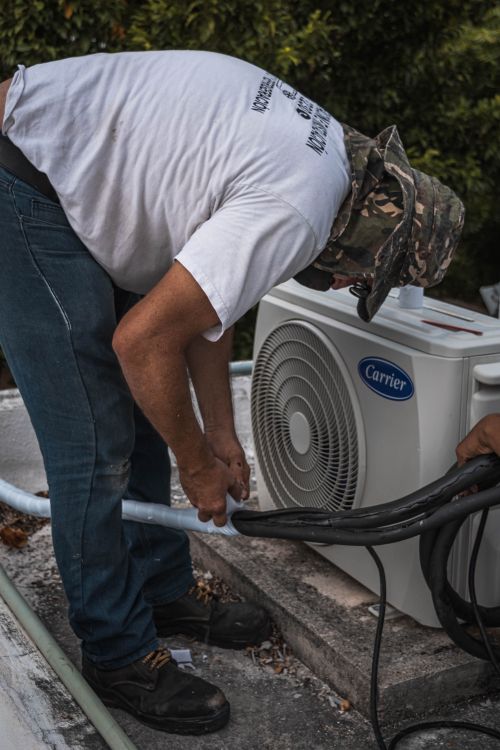
To weigh the repair cost against a new heat pump, including any national incentives available where you are, see our article R410A heat pump end of life: recharge cost and when to replace (currently in French).
For the technician, the usual obligations for handling refrigerant still apply. Under Article 10 of Regulation (EU) 2024/573, the people and companies carrying out this work need a certificate issued under their country’s national certification scheme, and refrigerant use has to be recorded. Our EU F-Gas compliance guide covers certification, leak checks and record-keeping.
For a new unit: R32, R454B or R290?
R32 dominates residential splits today, but the timeline above shows it isn’t meant to last in small new splits. Choosing a replacement unit therefore depends on capacity, type (air-to-air or air-to-water) and the site’s safety constraints. The three common options:
| Refrigerant | GWP | Class | Watch out for |
|---|---|---|---|
| R32 | 675 | A2L | Excluded from small new air-to-water (2027) and air-to-air (2029) splits, unless safety requirements apply |
| R454B | 466* | A2L | Same limit as R32 for small splits. Don’t confuse it with R454C (146) |
| R290 (propane) | 0.02 | A3 | Below the 150 threshold, but highly flammable: limited charges, especially indoors |
To compare these refrigerants in detail, see our low-GWP refrigerant guide and our complete R454B guide. Whatever you choose, the rule is the same as between R410A and R32: a unit runs on the refrigerant shown on its rating plate, and on nothing else.
Frequently Asked Questions
Can you put R32 in an existing R410A air conditioner?
No. We found no manufacturer that approves this replacement. R32 is classed A2L, mildly flammable, while the unit was designed and certified for an A1 refrigerant, and its discharge temperature, 13 to 20 K higher, puts stress on a compressor that wasn’t built for it. An R410A unit is serviced with R410A or replaced by a new unit designed for its own refrigerant.
Can you top up an R410A charge with R32?
No. R410A already contains 50% R32 and 50% R125: adding R32 shifts the composition, the resulting mixture is no longer R410A and the manufacturer’s settings no longer apply. The whole mixture must be recovered and sent to a treatment facility, then the circuit recharged with virgin or reclaimed R410A.
Will R410A be banned for servicing air conditioners and heat pumps?
Not under the current text. Since 1 January 2026, Article 13(4) of Regulation (EU) 2024/573 has banned gases with a GWP of 2,500 or more for servicing this equipment, and R410A (GWP 2,088) sits below that threshold. The 750 threshold that applies from 2032 (Article 13(5)) covers only stationary refrigeration equipment, excluding chillers.
Is the GWP of R410A 2,088 or 1,924?
Under Regulation (EU) 2024/573, it’s 2,088: Annex I gives 675 for R32 and 3,500 for R125, values based on the IPCC Fourth Assessment Report, and Annex VI requires the weighted average. The 1,924 figure is calculated with values from the Fifth Assessment Report. Either way, R410A stays between the 750 and 2,500 thresholds.
Can I use my R410A gauges and hoses for R32?
R32 saturation pressures are only about 2% above those of R410A, so a gauge and hose set rated for R410A generally covers the range, subject to the working pressure stated by its manufacturer. The recovery unit and vacuum pump, however, must be declared compatible with A2L refrigerants in their manufacturer’s instructions.
R32 or R410A: the bottom line
R32 and R410A run at almost the same pressure, and that’s why the confusion is so common. What separates them lies elsewhere: a discharge temperature 13 to 20 K higher, an A2L safety class and a unit certified for one refrigerant only. An R410A air conditioner doesn’t get converted to R32. It gets serviced with R410A, virgin or reclaimed, until its condition justifies replacement.
The regulation isn’t rushing you: no servicing deadline applies to R410A in air conditioners and heat pumps. For work on existing systems, our EU-compliant R410A comes in several cylinder sizes. You can view our certifications online.
Disclaimer: thermodynamic values are calculated under the stated conditions and may vary with the unit and operating conditions. Always refer to the manufacturer’s documentation. Regulatory information reflects the text of Regulation (EU) 2024/573 as consulted on 17 September 2026 and isn’t legal advice. For a question about your installation, contact us.