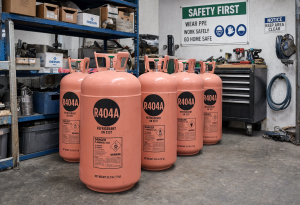
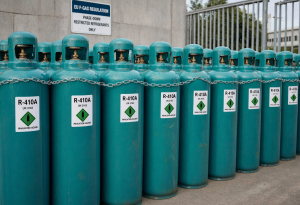
Step 1: Confirm Your National F-Gas Certification Is Valid
Across the EU, no distributor can legally sell refrigerant gas to a company that doesn’t hold a valid national F-gas certification. The certification framework itself is set at EU level, under Regulation (EU) 2015/2067 for personnel and Regulation (EU) 2015/2068 for companies, but each member state designates its own accredited certifying bodies and issuing process. For the full EU certification and leak-check process, see our EU F-Gas compliance guide.
Checklist before you buy, wherever you’re based in the EU:
- Valid company and personal F-gas certification, in the category that matches your activity (recovery, leak checks, installation, maintenance)
- At least one certified technician whose personal certificate is still within its validity period
- Certified equipment: recovery unit, leak detector, calibrated scale, vacuum pump
- An operational traceability system: equipment register, access to your national tracking platform
- Time needed: about 30 minutes to place the order, 2-4 days for delivery
- Difficulty: intermediate; the paperwork can look intimidating, but it’s routine once set up
Don’t have a valid certificate yet? Check your national F-gas authority or the process outlined in our compliance guide. Already certified? Skip ahead to Step 2.
Example: France’s Attestation de Capacite (ADC) system
To make this concrete, here is how one member state implements the certification requirement in practice. In France, the combined company-and-personnel certificate is called the Attestation de Capacite (ADC). Accredited certifying bodies issue roughly 12,000 new ADCs a year, and French distributors check this document systematically before any sale (ClimLab, 2026). Without a valid ADC, buying refrigerant in France is a category-3 offence carrying a €450 fine for the buyer.
France’s ADC is valid for 5 years. It is issued by a body accredited by the Ministry for Ecological Transition after three checks: staff competence, certified equipment, and a working traceability system (Bureau Veritas, 2026). Start the renewal 2 to 3 months before expiry.
Which ADC category covers buying R404A? (France example)
France’s system has 5 categories; three are relevant for buying and handling R404A:
| Category | Authorised activities | Average cost | Lead time |
|---|---|---|---|
| I | Installation, maintenance, leak checks, recovery, all equipment | €400 – 600 excl. VAT | 4-6 weeks |
| II | Maintenance, commissioning, recovery (equipment < 2 kg) + leak checks on all equipment | €450 – 650 excl. VAT | 4-6 weeks |
| III | Recovery only (equipment < 2 kg) | €350 – 550 excl. VAT | 4-6 weeks |
| IV | Leak checks only | €500 – 800 excl. VAT | 6-8 weeks |
| V | Vehicle air conditioning (French Highway Code scope) | €600 – 900 excl. VAT | 8-10 weeks |
For most technicians recharging cold rooms or refrigerated display cases, category I is the one that applies. It covers the full range of operations.
France’s 4 accredited certifying bodies (example)
In France, the ADC is issued by bodies accredited by the Ministry for Ecological Transition. Your own member state will have its own list of accredited bodies, but France’s are:
- Bureau Veritas: the most widely used, nationwide network
- DEKRA Certification: competitive pricing, fast turnaround
- SOCOTEC Certification: bundled offers for multi-site companies
- Qualiclimafroid: specialises in AC and refrigeration
Step 2: What Type of R404A Can You Legally Buy in 2026?
Regulation (EU) 2024/573 draws a clear line between three categories of fluid, and only one remains available to buy for servicing in 2026 (EUR-Lex, 2024). Mixing these categories up is expensive: using virgin gas for servicing exposes buyers to penalties of up to €75,000 in some member states.
Since 1 January 2025, only R404A reclaimed to the EN 13311-2 standard or recycled on-site can be used to service existing refrigeration equipment across the EU, and that window closes on 31 December 2029 (Regulation (EU) 2024/573, Art. 13(3)). Virgin gas is completely banned for this use.
| Type of R404A | Status in 2026 | Usable until | Restrictions |
|---|---|---|---|
| Virgin (new) | BANNED for servicing | Banned since 01/01/2025 | GWP ≥ 2,500: banned under Art. 13(3) |
| Reclaimed | ALLOWED | 31/12/2029 | Mandatory labelling, EN 13311-2 standard |
| Recycled | ALLOWED | 31/12/2029 | Same operator, or a subcontractor working on that operator’s behalf |
What’s the difference between reclaimed and recycled? Reclaimed fluid has been processed at a specialised facility to restore performance equivalent to new gas. Recycled fluid is simply cleaned by basic filtration. What you’ll find in a cylinder from a supplier is reclaimed gas.
For a full picture of the legal status of R404A, see our complete guide: is R404A still allowed in 2026?
Step 3: How Do You Choose a Reclaimed R404A Supplier?
Across the EU, reclaimed R404A in a 10kg cylinder currently sells for between €446 and €499, depending on the supplier and order volume (EuroRefrigerant, 2026). That’s a significant gap over pre-2025 virgin-gas prices, but shrinking HFC quotas keep this price structurally high.
What should you check with a supplier before ordering?
- Compliance with Regulation (EU) 2024/573: the supplier must be able to prove the gas is genuinely reclaimed, not simply repackaged
- Regulatory labelling: every cylinder must state “reclaimed”, the address of the reclamation facility, and a batch number
- Cylinders compliant with T-PED / EN 13322-1: refillable cylinders must meet this European standard
- Certificate of analysis: a document confirming the reclaimed fluid meets the ARI 700 purity specification
- A check on your own certification: a serious supplier will ask for your certificate number before selling
Under Regulation (EU) 2024/573, every cylinder of reclaimed R404A placed on the market must carry labelling that clearly states “reclaimed” status, the address of the reclamation site, and the batch number (Refrigerant Boys, 2026). Missing any of these makes the product non-compliant.
To compare reclaimed R404A prices across the EU, see our R404A price guide 2026.
Step 4: What Should You Check on the Label When You Receive It?
Labelling compliance is a recurring inspection focus across the EU. In France, for instance, roughly 15% of national inspections in 2025 focused on refrigerant labelling compliance, according to reports from the classified-installations inspectorate (DGPR, 2024). Receiving the cylinder isn’t just a logistics step, it’s a regulatory checkpoint.
On receipt, every cylinder of reclaimed R404A should be visually checked against the required labelling. Inspectors can request these documents during an unannounced audit, and the operator is jointly responsible with the supplier if the cylinder turns out non-compliant (based on France’s national implementing order, Arrete du 29/02/2016, AIDA-INERIS, used here as a national example of a wider EU obligation).
Receiving checklist:
- The word “RECLAIMED” clearly visible on the label
- Address of the reclamation facility: name and location of the accredited plant
- Batch number: full traceability back to the reclamation process
- Net weight and cylinder tare weight (needed for your annual fluid balance)
- Certificate of analysis attached or available on request
- T-PED compliance: CE marking and the cylinder’s requalification date
Why does this matter? Because if you’re ever inspected, it’s you, the operator, who has to prove the gas is genuinely reclaimed, not the supplier. Keep the delivery note and certificate of analysis for at least 5 years.
Step 5: Keep the Required Intervention and Recovery Records
Across the EU, Regulation (EU) 2024/573 requires operators to keep records of every intervention and refrigerant quantity handled, for at least 5 years (Art. 7). The exact form the record takes, and the platform used to track recovered fluid as hazardous waste, differs by member state. For the full EU record-keeping obligation, see our EU F-Gas compliance guide.
Example: France’s CERFA 15497, BSFF and equipment register
France implements this obligation through three linked documents. The CERFA 15497*04 is the mandatory intervention form for any operation on a circuit containing refrigerant, including a simple recharge (C-Fluide, 2022). Combined with the BSFF and the equipment register, it forms the traceability trio that French inspectors check first.
Document 1: the intervention form (France: CERFA 15497*04)
This form is completed for every intervention on a refrigeration circuit: recharging, leak checking, commissioning and fluid recovery.
Information to record:
- Equipment identification (type, location, nominal charge)
- Nature of the intervention (recharge, maintenance, repair)
- Quantity of fluid added or removed, in kilograms
- Type and status of the fluid (reclaimed, recycled, virgin)
- Identity and certificate number of the technician
Retention: at least 5 years, available to inspectors and to any operator who intervenes later.
Document 2: the hazardous-waste tracking document (France: BSFF via TrackDechets)
The Bordereau de Suivi des Fluides Frigorigenes (BSFF) has been mandatory in electronic form on the TrackDechets platform in France since 1 January 2023 (TrackDechets FAQ). It specifically applies to fluid recovery, not to a simple recharge.
A waste-tracking document is required whenever a professional recovers refrigerant from a circuit, since recovered fluid is classed as hazardous waste. In France, the TrackDechets platform run by the Ministry for Ecological Transition provides full digital traceability from the emitter to the treatment centre (TrackDechets, 2023). Penalties for non-compliance can reach €75,000.
When is a hazardous-waste document required? (France example)
- You recover fluid from a circuit: BSFF required
- You do a simple recharge without recovery: the CERFA 15497 is enough, no BSFF needed
- You replace a compressor and recover the fluid: BSFF required
Document 3: the equipment register
Every piece of equipment holding more than 2 kg of refrigerant needs a register recording, in chronological order, all intervention records (AFCE). Keeping it is the responsibility of the equipment owner, not the technician.
This register can be kept electronically. It should show the type and quantity of fluid the equipment holds, leak-check results, and maintenance operations carried out.
Step 6: File Your Annual Fluid Balance Where Your Country Requires It
Most EU member states tie an annual reporting obligation to the F-gas certification itself: you report your fluid stocks, purchases, charges and recoveries for the year, typically even if you handled zero refrigerant (a nil declaration). In France, this is done between 1 and 31 January each year on the Datafluides.fr platform (Qualiclimafroid, 2026). Skip it, and your certificate can be suspended.
In France, the annual declaration on Datafluides.fr is a regulatory obligation for any company holding an Attestation de Capacite. It records new and used fluid stock on 1 January and 31 December, plus the quantities bought, charged, recovered and returned during the year (DEKRA Certification, 2026).
Data to report for R404A (France example, the categories are similar in most member states):
- Stock of virgin fluid on 1 January and 31 December (should be 0 for virgin gas)
- Stock of reclaimed/used fluid on 1 January and 31 December
- Quantities bought during the year (net weight, tare deducted)
- Quantities charged into equipment
- Quantities recovered and sent for reclamation or destruction
If your purchase, charging and stock figures don’t add up, the certifying body will ask for supporting evidence. Real-time tracking through the year is far more comfortable than a scramble at the deadline.
What Mistakes Should You Avoid When Buying R404A?
Nearly 30% of the non-compliance issues French inspectors found in 2024 involved traceability gaps on refrigerants, not the use of the wrong gas (DGPR, 2024). Here are the most common mistakes seen on the ground, wherever you’re buying.
1. Ordering without checking your certification’s expiry date
National F-gas certificates like France’s ADC typically run for several years. Many professionals lose track of the expiry date and find themselves blocked the day they need an urgent cylinder. Fix: set a reminder 3 months before the deadline and start the renewal immediately.
2. Accepting a cylinder without a “reclaimed” label
If the label doesn’t explicitly state reclaimed status, the reclamation facility address and the batch number, the cylinder isn’t compliant. And it’s you who pays the fine, not the delivery driver. Refuse delivery if these details are missing.
3. Forgetting the hazardous-waste document when recovering fluid
The intervention record covers the job itself. But the moment you remove fluid from a circuit, you also need a hazardous-waste tracking document (in France, the BSFF via TrackDechets). Many technicians only fill in the intervention form. That’s not enough, and the fine for a missing hazardous-waste document can reach €75,000 in France.
4. Not weighing cylinders on receipt
The net weight stated on the label should match the cylinder’s actual weight. A significant gap can point to a quality problem or a cylinder that’s already been used. Weigh every delivery and log the weight in your register.
5. Confusing “recycled” with “reclaimed” at the point of purchase
Recycled fluid (basic filtration only) can only be used by the same operator or their subcontractor. It isn’t placed on the market in cylinders. If a seller offers “recycled” R404A in a cylinder, treat that as a red flag. Anything you buy in a cylinder from a distributor is, by definition, reclaimed.
What Are the Penalties for Non-Compliance?
Regulation (EU) 2024/573 (Art. 31) requires every member state to set penalties that are effective, proportionate and dissuasive, but the actual amounts, offence classes and enforcement authorities differ by country. The table below shows France’s penalty framework as a worked example, ranging from a simple fine to imprisonment (Legifrance, Art. R543-122 to R543-123).
| Offence | Class | Fine | Additional penalty |
|---|---|---|---|
| Buying fluid without a valid certificate | Category 3 | €450 | Seizure of the fluid |
| Intervening without a valid certificate | Category 5 | €1,500 | Doubled on repeat offence |
| Using virgin R404A for servicing | Criminal offence | up to €75,000 | Up to 2 years’ imprisonment |
| Missing traceability documents | Criminal offence | up to €75,000 | Up to 2 years’ imprisonment |
| Missing annual declaration | Administrative | Certificate suspension | Ban on operating |
Check your own national F-gas authority for the equivalent penalty schedule where you operate; the framework above is France’s, used as an illustration of how strict enforcement can get.
Should You Already Be Switching to an R404A Alternative?
Reclaimed R404A stays available until 2030, but its price will only keep climbing as HFC quotas tighten further: a 57% cut in EU HFC quotas is planned between 2029 and 2030 (Dalkia Froid Solutions, 2024). For installations due for renewal, alternatives already exist.
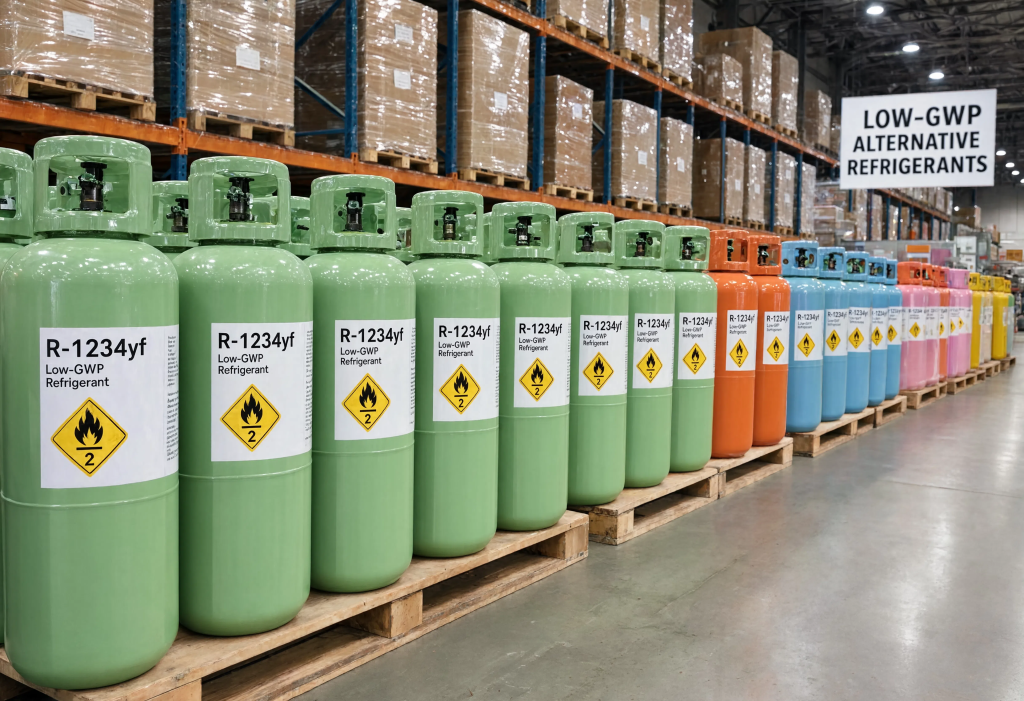
R-449A (GWP 1,397) and R-448A (GWP 1,387) have become the direct replacements for R404A in commercial refrigeration systems, offering comparable energy performance with a GWP cut of over 64% (ABCClim, 2025). For new installations, R-290 (propane, GWP 3) and R-744 (CO2, GWP 1) are the long-term solutions.
For existing installations, the pragmatic strategy is to keep running on reclaimed R404A while planning the transition. A full comparison of the available alternatives is on our roadmap and not yet published, so for now the general guidance above is your starting point.
Frequently Asked Questions
Can I still buy virgin R404A in 2026?
No. Since 1 January 2025, virgin R404A (GWP 3,922) has been banned for servicing and maintaining any refrigeration equipment across the EU, under Article 13(3) of Regulation (EU) 2024/573. Only reclaimed or recycled R404A remains legally available, until 31 December 2029.
How much does a cylinder of reclaimed R404A cost in 2026?
Across the EU, a 10kg cylinder of reclaimed R404A typically costs between €446 and €499, roughly €45-50 per kilogram, depending on the supplier. On top of that, some member states apply their own environmental levy, for example France’s eco-tax of around €6.42/kg. Prices have risen roughly 30% since 2023 as EU-wide HFC quotas shrink.
What happens if I buy R404A without a valid F-gas certification?
Every EU member state sets its own penalties under Regulation (EU) 2024/573, Art. 31. In France, for example, buying refrigerant without a valid Attestation de Capacite is a category-3 offence carrying a €450 fine, and intervening on a circuit without one is a category-5 offence at €1,500, doubled on a repeat offence. In case of an accident, civil and criminal liability applies and professional insurance typically does not cover the resulting damages.
What is the difference between an intervention record and a hazardous-waste document?
An intervention record (in France, the CERFA 15497 form) is required for any operation on a refrigeration circuit. A hazardous-waste tracking document (in France, the BSFF via TrackDechets) is different: it is only required when fluid is recovered from a circuit, since recovered refrigerant is classed as hazardous waste. When you recover fluid, you need both documents, and both should be kept for at least 5 years.
Will R404A be totally banned by 2030?
Yes. From 1 January 2030, even reclaimed R404A can no longer be used to service refrigeration equipment in the EU. Operators will need to convert their systems to a lower-GWP fluid (R449A, R448A) or switch to natural solutions using CO2 or propane.
How Do You Secure Your Next R404A Purchase?
Buying R404A in 2026 is possible, but only within a strict regulatory framework. Here’s what to remember:
- Valid national F-gas certification: check the expiry date and start renewal 3 months ahead
- Reclaimed R404A only: virgin gas has been banned since January 2025
- Certified supplier: “reclaimed” label + facility address + batch number
- Complete traceability: an intervention record, a hazardous-waste document when fluid is recovered, and an updated equipment register
- Annual reporting: filed to your national platform on the deadline your country sets (France: by 31 January)
The window is closing: reclaimed R404A stays available until 2030. Between now and then, plan your transition to lower-GWP fluids. It’s an investment, not just a cost.
To go further, read our detailed analysis of R404A’s legal status in 2026 and our R404A price comparison across the EU.
Disclaimer: fine amounts, prices and procedures are indicative and evolve with the regulation. Always check the official texts and consult an accredited certifying body in your member state before taking action.