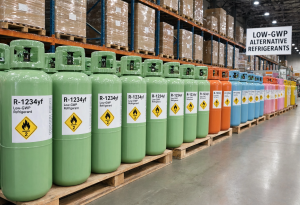
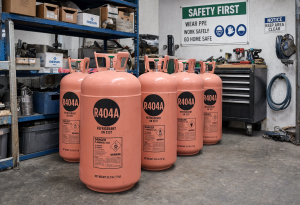
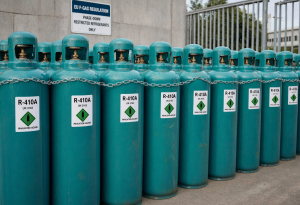
Since January 2025, virgin R404A can no longer be used to service stationary refrigeration equipment in the EU. Regulation 2024/573 bans virgin HFCs with a GWP of 2,500 or higher for that purpose, and R404A’s GWP of 3,922 puts it firmly on the wrong side of the line (EU Regulation 2024/573, Art. 13). That leaves thousands of operators across Europe with R404A systems that still have years of service life. What do you charge them with?
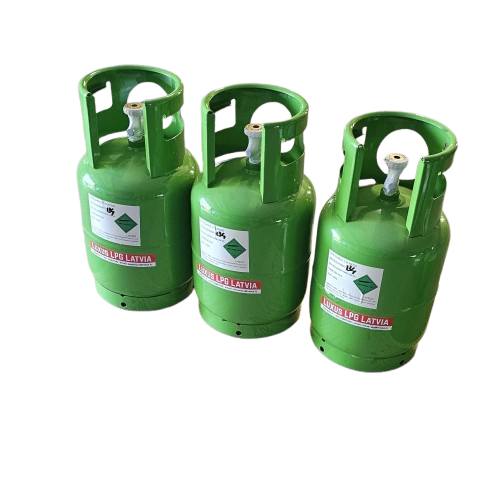
R407F is the most widely adopted A1 (non-flammable, non-toxic) retrofit refrigerant for these systems. It cuts GWP by 53% compared to R404A, delivers 5-15% energy savings in real-world installations (Honeywell Verco case study), and requires no special safety equipment. Over 15,000 European supermarkets had already converted to R407F by 2016 (Cooling Post, 2016). That number has grown substantially since the F-Gas III regulation tightened the screw.
For the full regulatory context, see our 2026 EU F-Gas Regulation overview. This guide covers everything a refrigeration professional needs to know about R407F: its physical properties, how it compares to R404A and other alternatives, the step-by-step retrofit process, its regulatory future under F-Gas III, and how to source it. Whether you’re planning your first conversion or your fiftieth, the data and procedures here will keep you current through 2032 and beyond.
Key Takeaways

What Is R407F Refrigerant?
R407F is a zeotropic HFC blend containing 30% R-32, 30% R-125, and 40% R-134a by mass, with a GWP of 1,824 under IPCC AR4 100-year values (Honeywell EU). ASHRAE Standard 34 classifies it as A1, meaning non-toxic and non-flammable. The blend was developed by Honeywell and marketed under the trade name Genetron Performax LT as a retrofit replacement for R404A and R507A in commercial refrigeration.
R407F Composition and Trade Name
The three components each serve a specific thermodynamic purpose. R-32 provides cooling capacity and improves energy efficiency. R-125 suppresses flammability, which is why the blend achieves A1 classification despite containing 30% R-32. R-134a fills the balance, bringing the operating pressures close to R404A’s range.
A common point of confusion: R407F is not R407C. The two share the same three components but in very different ratios. R407C uses 23% R-32, 25% R-125, and 52% R-134a, giving it different operating pressures and a much lower capacity at low temperatures. If a supplier or data sheet mixes up these blends, the system will underperform or fail. Always verify the 30/30/40 composition on the cylinder label before charging.
A1 Safety Classification: Why It Matters
R407F’s A1 classification under ASHRAE Standard 34 means it is non-flammable and non-toxic at concentrations below the occupational exposure limit. This is a significant practical advantage over A2L alternatives like R454C or R455A. Why? Because A1 refrigerants carry no charge-size restrictions under EN 378, require no ATEX-rated electrical components in the machine room, and need no refrigerant leak detectors for flammability purposes.
In our experience advising operators across Europe, the A1 classification is the single biggest reason mid-size retailers choose R407F over lower-GWP A2L alternatives. The cost of retrofitting electrical systems to ATEX standards in an existing cold room often exceeds the cost of the entire refrigerant conversion.
For operators with existing R404A systems in occupied retail spaces, the A1 classification eliminates an entire layer of compliance work. No risk assessments for flammable refrigerants. No updated emergency procedures. No staff training for leak scenarios involving ignition sources. The system behaves, from a safety standpoint, exactly like the R404A it replaces.
Zeotropic Blend and Temperature Glide
R407F is a zeotropic blend with a temperature glide of approximately 6.0-6.4 K (National Refrigerants). That means the refrigerant evaporates and condenses across a range of temperatures rather than at a single point. R404A, by contrast, has a glide of only 0.7 K, which makes it behave almost like a pure substance. The practical effect? You need to think about whether your gauges are reading bubble point, dew point, or midpoint temperature when setting superheat and subcooling.
What Are R407F’s Technical Properties?
R407F has a boiling point of -46.06 degrees C at atmospheric pressure, nearly identical to R404A’s -46.22 degrees C (Gas Servei TDS, 2024). This close match in boiling points is one reason R407F works so well as an R404A retrofit. The full specifications below are drawn from Honeywell EU technical data and verified against multiple independent sources.
| Property | Value | Source |
|---|---|---|
| ASHRAE Designation | R-407F | ASHRAE Std 34 |
| Trade Name | Genetron Performax LT | Honeywell |
| Composition (mass %) | R-32 (30%), R-125 (30%), R-134a (40%) | Honeywell EU |
| Molecular Weight | 82.06 g/mol | Honeywell EU |
| Boiling Point (at 1.013 bar) | -46.06 degrees C | Gas Servei TDS, 2024 |
| Critical Temperature | 82.66 degrees C | Honeywell EU |
| Critical Pressure | 47.55 bar | Honeywell EU |
| Liquid Density (0 degrees C) | 1,116.93 kg/m3 | Honeywell EU |
| Vapor Density (25 degrees C) | 47.52 kg/m3 | Honeywell EU |
| Temperature Glide | ~6.0-6.4 K | National Refrigerants |
| GWP (AR4, 100-yr) | 1,824 | IPCC AR4 / Honeywell |
| GWP (AR5, 100-yr) | 1,674 | Climatiq / BEIS-Defra |
| ODP | 0 | Honeywell EU |
| Safety Classification | A1 (non-toxic, non-flammable) | ASHRAE Std 34 |
| Compatible Lubricant | POE (Polyol Ester) oil | Honeywell / National Ref |
| Blend Type | Zeotropic | All sources |
Pressure-Temperature Reference Points
Because R407F is zeotropic, any PT chart must specify whether it shows bubble point or dew point temperatures. The table below gives bubble-point values at selected pressures, which is what most technicians use when setting subcooling at the condenser outlet. For evaporator superheat, use dew-point values instead.
| Pressure (bar gauge) | Bubble Temp (degrees C) | Dew Temp (degrees C) | Glide (K) |
|---|---|---|---|
| 1.0 | -36.5 | -30.6 | 5.9 |
| 3.0 | -22.2 | -16.2 | 6.0 |
| 5.0 | -12.0 | -5.9 | 6.1 |
| 8.0 | 0.2 | 6.4 | 6.2 |
| 12.0 | 14.6 | 20.8 | 6.2 |
| 16.0 | 26.9 | 33.2 | 6.3 |
| 20.0 | 37.8 | 44.2 | 6.4 |
Notice the glide increases slightly at higher pressures. At typical medium-temperature condensing conditions (16-20 bar gauge), you’re looking at about 6.3-6.4 K of glide. This affects TXV superheat settings, which we’ll cover in the retrofit section below.
POE Oil Compatibility
R407F requires polyol ester (POE) lubricant. If the existing R404A system already runs on POE oil, you may not need to change it. Many modern R404A systems do. However, older systems originally charged with R22 and later converted to R404A may still contain mineral oil or alkylbenzene (AB) residues. In that case, a full oil change to POE is mandatory before charging R407F.
POE oil is hygroscopic. It absorbs moisture from the air rapidly. Keep containers sealed until the moment of use, and minimize the time the system is open during servicing. Residual moisture causes acid formation, which corrodes copper tubing and damages compressor bearings.
How Does R407F Compare to R404A?
R407F’s GWP of 1,824 is 53% lower than R404A’s 3,922 (IPCC AR4, Honeywell EU), and real-world retrofits consistently show energy savings of 5-15% at comparable operating conditions (Honeywell Verco case study). The two refrigerants share nearly identical boiling points, which is why R407F slots into R404A hardware with relatively few modifications.

| Property | R404A | R407F | Difference |
|---|---|---|---|
| GWP (AR4, 100-yr) | 3,922 | 1,824 | -53% |
| Boiling Point (1.013 bar) | -46.22 degrees C | -46.06 degrees C | Nearly identical |
| Temperature Glide | ~0.7 K | ~6.0-6.4 K | Significant increase |
| Safety Classification | A1 | A1 | Same |
| Lubricant | POE | POE | Same type |
| Energy Efficiency vs R404A | Baseline | +5-15% | R407F better |
| Discharge Temperature | Baseline | Higher (+10-15 K typical) | Monitor needed |
| Cooling Capacity (LT) | Baseline | ~95-98% | Slightly lower at LT |
| Cooling Capacity (MT) | Baseline | ~100-105% | Equal or slightly higher |
GWP Comparison Across R404A Alternatives
Where does R407F sit among the available R404A replacements? The chart below puts the numbers in perspective. R407F isn’t the lowest-GWP HFC option available, but it offers the best balance of GWP reduction, A1 safety, and retrofit simplicity for existing systems. Lower-GWP options like R448A and R449A exist, but they are A1 blends with similar trade-offs. Natural refrigerants like CO2 and propane have near-zero GWP but require entirely new system designs.
Real-World Energy Savings
Lab-tested COP numbers tell part of the story. Field data from actual retrofits paints the full picture. The Verco project in the UK documented a 5% COP improvement and up to 15% total system energy savings after converting from R404A to R407F (Honeywell EU case study). That 15% figure includes the compound effect of better thermodynamic efficiency plus optimized system controls.
Intermarche, a major French supermarket chain, reported 10% energy savings across its converted stores (Honeywell/Cooling Post). ASDA trials in the UK showed 14% savings specifically at medium-temperature display cases (Cooling Post). These aren’t theoretical projections. They’re measured results from metered systems running real product loads. But have you checked whether those savings apply to your specific system configuration?
The energy savings gap between medium-temperature and low-temperature applications is something most data sheets don’t emphasize. R407F’s efficiency advantage over R404A is strongest at medium temperatures (-5 to +5 degrees C evaporating). At deep-freeze temperatures below -30 degrees C, the advantage narrows because R407F’s slightly lower volumetric capacity at very low temperatures partially offsets its better COP.
One important caveat: discharge temperatures run 10-15 K higher with R407F than with R404A. In systems that already operate near the compressor manufacturer’s temperature limits, this needs monitoring. Some installations require a discharge temperature sensor connected to the controller, with a high-limit alarm set per the compressor OEM’s recommendations.
Why Are EU Operators Switching to R407F?
EU Regulation 2024/573 set the HFC quota for 2025-2026 at 42.9 Mt CO2-equivalent, 48% below the baseline (Regulation 2024/573). That quota squeeze drives up the cost of high-GWP refrigerants and makes lower-GWP alternatives like R407F increasingly attractive for economic as well as regulatory reasons.
The R404A Virgin Gas Ban
Article 13 of Regulation 2024/573 prohibits the use of virgin HFCs with a GWP of 2,500 or higher for servicing stationary refrigeration equipment, effective January 1, 2025. R404A (GWP 3,922), R507A (GWP 3,985), and R422D (GWP 2,729) are all affected. Operators can still use reclaimed or recycled R404A, but supply is limited and prices are climbing. For many operators, converting to R407F is cheaper than sourcing reclaimed R404A over a multi-year service period.
HFC Quota Fee from 2026
Starting in 2026, producers and importers of HFCs in the EU will pay a quota fee of EUR 3 per tonne of CO2-equivalent (Regulation 2024/573). For R407F, with a GWP of 1,824, that translates to roughly EUR 5.47 per kilogram of refrigerant. It’s not trivial, but it’s manageable. Compare that to what a similar fee would add to R404A’s cost: EUR 11.77 per kilogram. The economics tilt decisively toward lower-GWP options.
A1 Advantage Over A2L Competitors
Several lower-GWP alternatives carry A2L (mildly flammable) safety classifications. R454C, R455A, and various HFO blends fall into this category. While their GWP numbers look better on paper, the A2L classification triggers significant practical requirements under EN 378:2016+A1:2020. Charge-size limits apply based on room volume and LFL concentration. Electrical components in the refrigerant circuit zone may need ATEX rating. Refrigerant leak detection systems with alarm thresholds at 25% of the LFL become mandatory in most occupied-space configurations (EN 378, Part 1, Section 6.2).
We’ve seen retrofit budgets double when operators discover midway through a project that converting to an A2L alternative requires new electrical switchgear, leak detection panels, and ventilation modifications. For an existing cold room in a building that wasn’t designed for flammable refrigerants, R407F’s A1 classification avoids these costs entirely.
For new-build projects with proper design budgets, A2L or natural refrigerants may be the right choice. For retrofit of existing R404A equipment with remaining service life, R407F’s A1 classification keeps the project scope focused on the refrigerant change itself, not the building infrastructure around it.
Where Is R407F Used?
More than 15,000 European supermarkets had converted to R407F by 2016, making it the most widely deployed R404A alternative in commercial refrigeration at the time (Cooling Post, 2016). The blend performs best in medium-temperature applications from -5 to +5 degrees C evaporating, where its efficiency advantage over R404A is most pronounced.

Supermarket Display Cases
Medium-temperature display cases for fresh food, dairy, and beverages are R407F’s strongest application. Intermarche recorded 10% energy savings across its French stores after converting display-case circuits from R404A (Honeywell/Cooling Post). ASDA’s UK trials showed 14% savings in medium-temperature cabinets specifically (Cooling Post). These results reflect R407F’s higher COP at medium evaporating temperatures.
Cold Rooms and Walk-In Freezers
R407F works in low-temperature applications down to about -35 degrees C evaporating, though its capacity advantage over R404A narrows at these temperatures. For walk-in freezers and cold rooms, the Verco case study documented a 5% COP improvement with up to 15% overall energy savings when system controls were optimized simultaneously (Honeywell EU). Discharge temperature monitoring becomes more important in low-temperature duty because the compressor runs hotter.
Food Processing and Transport Refrigeration
Food processing plants with R404A condensing units have adopted R407F for the same reasons supermarkets have: regulatory compliance, energy savings, and A1 simplicity. Transport refrigeration is another growing application, though some transport units use R452A instead. The choice often depends on the OEM’s recommendation for that specific compressor model. JD Cooling in the UK reported a 25% running cost reduction when converting cold-storage units from R22 to R407F (ACR Journal, 2013).
How Do You Retrofit an R404A System to R407F?
A properly executed R407F retrofit takes 4-8 hours for a typical commercial system and delivers immediate GWP reduction of 53%, from 3,922 to 1,824 (IPCC AR4, Honeywell EU). The process is straightforward but not a simple gas swap. R407F’s zeotropic nature and higher discharge temperatures require specific handling steps that differ from a like-for-like R404A recharge.
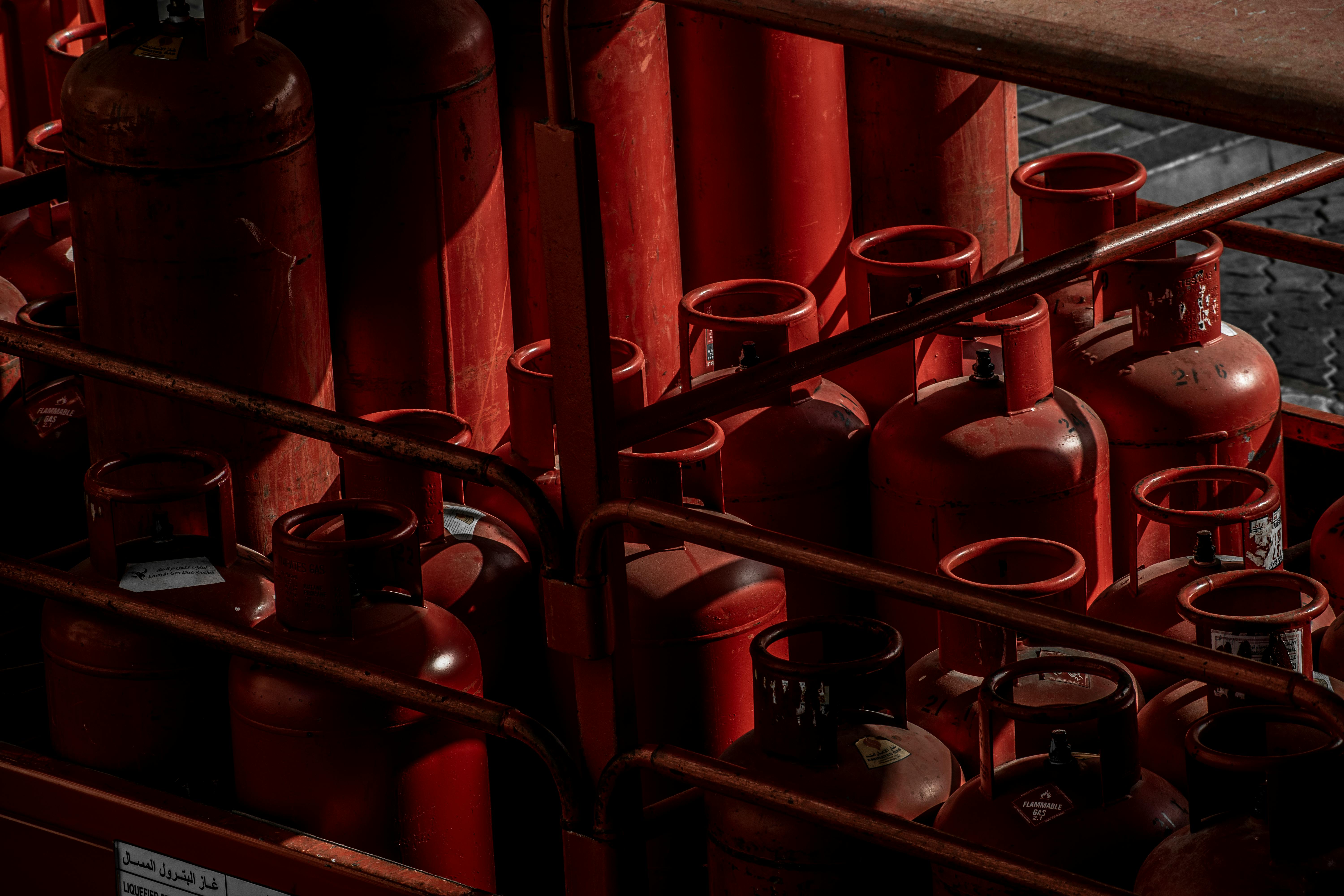
Six-Step Retrofit Process
- System assessment and baseline recording. Document current operating pressures, temperatures, superheat, subcooling, and energy consumption before making any changes. Record the R404A charge weight. Check the compressor manufacturer’s compatibility bulletin for R407F approval. Photograph valve settings and controller parameters.
- Recover existing R404A. Pump down and recover the full R404A charge into certified recovery cylinders. This refrigerant can be sent for reclamation under Regulation 2024/573. Never vent it. Never mix it with the new R407F charge. Label the recovery cylinder clearly.
- Check and change lubricant to POE if needed. R407F requires POE oil. If the system already uses POE (most modern R404A systems do), check oil condition, acidity, and moisture content. If the system contains mineral oil or AB oil from a previous R22 conversion, drain and replace with the POE grade specified by the compressor manufacturer. Replace the filter-drier core at the same time.
- Charge R407F in liquid phase only. This step is critical. R407F is a zeotropic blend, and its three components have different boiling points. If you charge in vapor phase, the composition leaving the cylinder will not match the specification. Always charge liquid from an inverted cylinder or through the cylinder’s dip tube. Weigh the charge to the manufacturer’s recommended weight.
- Adjust expansion valve (TXV) superheat settings. R407F’s 6K temperature glide means the evaporator outlet temperature is higher than the inlet temperature at the same pressure. TXV superheat should be set using dew-point temperature from the R407F PT chart, not bubble point. Typical superheat targets are 6-8 K for medium-temperature applications and 8-12 K for low-temperature. Adjust the TXV setting incrementally and allow the system to stabilize for 15-20 minutes between adjustments.
- Verify performance and log readings. Run the system under representative load conditions for at least 2 hours. Record suction pressure, discharge pressure, suction temperature, discharge temperature, liquid-line temperature, superheat, and subcooling. Compare against baseline R404A readings. Discharge temperature will be 10-15 K higher, which is normal. Set a high-limit alarm if the compressor OEM specifies one.
For the full step-by-step with photographs and valve settings, see our detailed R407F retrofit procedure.
Common Mistakes to Avoid
The most frequent error we see is vapor-phase charging. Technicians accustomed to near-azeotropic R404A sometimes charge R407F the same way. Don’t. Vapor charging a zeotropic blend causes fractionation: the lighter R-32 component (boiling point -51.7 degrees C) evaporates preferentially, leaving the heavier R-134a behind (Honeywell Retrofit Guidelines). The resulting charge will underperform and may damage the compressor.
The second most common mistake is ignoring discharge temperature. R407F runs hotter than R404A. If a system already operates with marginal compressor head cooling, the additional 10-15 K from R407F can push discharge temperatures into the danger zone. Always install a discharge temperature sensor and set the controller to cut out at the compressor OEM’s specified limit.
Third: topping up an R404A charge with R407F. Never do this. Mixing refrigerants is illegal under EU F-Gas Regulation and creates an uncontrolled blend with unpredictable properties. The system must be fully evacuated of R404A before R407F is charged.
What Is R407F’s Regulatory Future Under EU F-Gas III?
R407F remains fully legal for new installations and service until January 2030, with service-only legality continuing until January 2032. From January 2032, Regulation 2024/573 bans virgin HFCs with a GWP of 750 or higher for servicing non-chiller stationary refrigeration equipment (Regulation 2024/573, Art. 13). R407F’s GWP of 1,824 exceeds that threshold, so virgin R407F will become unavailable for service after 2031.
R407F as a Transitional Refrigerant
The practical service window for R407F spans roughly 2025 to 2031, about seven years from now. That’s long enough to justify a retrofit of any R404A system with significant remaining useful life. Equipment installed or converted today will run on virgin R407F for another five to six years. After 2032, reclaimed or recycled R407F may extend that window further, though supply will depend on the reclamation market.
Should you be planning the next transition already? In most cases, yes. If you’re building new cold-chain infrastructure, design it for natural refrigerants like CO2 (R744) or propane (R290). If you’re maintaining existing equipment, R407F buys you a compliant, cost-effective bridge while you plan and budget for the long-term shift. The worst strategy is doing nothing and waiting for R404A prices to spike further.
How Does R407F Compare to Other R404A Alternatives?
R407F sits in the middle of the GWP range among R404A replacements, with a GWP of 1,824 (IPCC AR4, Honeywell EU). Lower-GWP HFC/HFO blends like R448A (GWP 1,387) and R449A (GWP 1,397) offer greater GWP reduction, while natural refrigerants like CO2 and propane eliminate the GWP issue entirely but require purpose-built systems.
| Refrigerant | GWP (AR4) | Safety Class | Retrofit from R404A? | Best Suited For | 2032 Service Legal? |
|---|---|---|---|---|---|
| R407F | 1,824 | A1 | Yes (POE, TXV adjust) | MT/LT commercial, retrofit focus | Reclaimed only |
| R448A (Solstice N40) | 1,387 | A1 | Yes (POE, TXV adjust) | MT/LT commercial, lower GWP priority | Reclaimed only |
| R449A (Opteon XP40) | 1,397 | A1 | Yes (POE, TXV adjust) | MT/LT commercial, similar to R448A | Reclaimed only |
| R744 (CO2) | 1 | A1 | No (new system) | New-build supermarkets, industrial | Yes (exempt) |
| R290 (Propane) | 3 | A3 | No (new system) | Small charge, self-contained units | Yes (exempt) |
When Each Alternative Fits Best
R407F is the strongest choice when you need A1 safety, minimal system modifications, and a proven retrofit path from R404A. It’s particularly well-suited for operators who need to act now but don’t have the capital for a full system replacement. The 53% GWP reduction satisfies current regulations and buys time to plan a long-term natural-refrigerant strategy.
R448A and R449A offer slightly lower GWP and may be preferred where regulatory scoring or carbon accounting matters. Both are also A1, and the retrofit process is similar to R407F. The choice between them often comes down to which manufacturer’s technical support is available in your region.
CO2 transcritical systems are the long-term answer for new supermarket builds. They’re GWP-proof and exempt from all quota restrictions. But they can’t retrofit into existing R404A hardware. The same applies to R290 propane, which suits self-contained display cases and small charge applications where A3 flammability is manageable.
Managing R407F Temperature Glide in Practice
R407F’s temperature glide of approximately 6.0-6.4 K (National Refrigerants) is the single biggest operational difference from R404A’s near-azeotropic behavior. Understanding how glide affects evaporator and condenser performance is essential for getting the best efficiency from a converted system. Ignoring it leads to poor superheat control, reduced capacity, and wasted energy.
Glide in the Evaporator
In the evaporator, the refrigerant enters as a liquid-vapor mix at the bubble-point temperature and exits as superheated vapor at a temperature above the dew point. With R407F, the bubble point at a given pressure is about 6 K lower than the dew point (National Refrigerants). This means the evaporator coil temperature isn’t uniform. It’s coldest at the inlet and warmest at the outlet.
Counter-flow heat exchangers benefit from this characteristic. When air or product flows in the opposite direction to the refrigerant, the temperature difference between the two remains relatively constant along the coil. Parallel-flow arrangements suffer a mismatch, with a large temperature difference at one end and almost none at the other. If your evaporator coils use parallel-flow circuiting, expect slightly reduced capacity compared to counter-flow designs.
Superheat Setting Adjustments
When measuring superheat on an R407F system, you must use the dew-point temperature at the measured suction pressure. This is different from R404A practice, where bubble and dew points are nearly identical. If you accidentally use the bubble-point value from the PT chart, your calculated superheat will appear 6 K higher than it actually is, and you’ll adjust the TXV in the wrong direction.
Set superheat at 6-8 K for medium-temperature applications and 8-12 K for low-temperature duty. Allow 15-20 minutes of stable operation between adjustments. Quick changes lead to hunting, where the TXV oscillates between too much and too little flow.
For a deeper technical analysis, see our R407F energy performance and optimization guide.
Tools and Resources for R407F
Working with R407F requires access to the right reference materials and tools. The technical data sheet from Honeywell remains the primary source for thermodynamic properties, with verified data covering pressures, temperatures, and densities across the full operating range (Honeywell EU). Below are the key resources every technician and engineer should have available.
- Honeywell Performax LT Technical Data Sheet – Full thermodynamic properties, safety data, and PT chart. Available from Honeywell’s Fluorine Products division or your distributor.
- R407F Pressure-Temperature Charts – Available in metric (bar/degrees C) format from Honeywell, National Refrigerants, and refrigerant calculator apps. Always verify whether the chart shows bubble or dew point.
- EN 378:2016+A1:2020 – European standard for refrigerating systems and heat pumps. Covers safety and environmental requirements. Relevant sections: Part 1 (basic requirements), Part 2 (design, construction, testing), Part 4 (operation, maintenance, repair).
- EU F-Gas Certification Directories – Each EU member state maintains a registry of certified F-Gas technicians. Verify your technician’s certification before commissioning any refrigerant work.
- Regulation 2024/573 Full Text – Available on EUR-Lex. Read Articles 11 (placing on market restrictions), 13 (service restrictions), and Annex VII (quota schedule).
Getting Started with R407F
Converting your R404A systems to R407F follows a logical sequence. Start with an audit, then engage qualified professionals, and finally source the refrigerant. Here’s how to move forward.
- Audit your R404A systems for retrofit eligibility. Check compressor manufacturer bulletins for R407F compatibility. Verify lubricant type (POE required). Note system age, charge size, and remaining service life. Systems with less than three years of expected life may not justify the conversion cost.
- Engage a certified F-Gas technician. Under EU Regulation 2024/573, Article 10, all refrigerant handling must be performed by or supervised by personnel holding valid F-Gas certification for the relevant category (Category I covers all charge sizes). Verify certification status through your member state’s national registry before signing a work order.
- Source quality R407F refrigerant. Purchase from a reputable EU supplier with full traceability documentation. Each cylinder should include a certificate of analysis confirming the 30/30/40 composition. R407F is available through Refrigeration Store EU in standard cylinder sizes for commercial applications.
What is R407F made of?
R407F is a zeotropic blend of three HFC refrigerants: 30% R-32, 30% R-125, and 40% R-134a by mass (Honeywell EU). Its trade name is Genetron Performax LT. The blend delivers operating pressures close to R404A while reducing GWP by 53%, from 3,922 to 1,824 (IPCC AR4). Do not confuse it with R407C, which uses a different ratio of the same three components (23/25/52).
Is R407F flammable?
No. R407F carries an ASHRAE A1 safety classification, meaning it is non-toxic and non-flammable (ASHRAE Standard 34). Unlike A2L alternatives such as R454C, R407F requires no refrigerant leak detectors for flammability, no charge-size limits under EN 378, and no ATEX-rated electrical components in the machine room. Standard refrigeration safety practices apply.
Can you drop R407F directly into an R404A system?
Not exactly. R407F is a retrofit refrigerant, not a true drop-in. You must recover the full R404A charge first, verify or change the lubricant to POE oil, and adjust TXV superheat settings for R407F’s 6K temperature glide (National Refrigerants). Mixing refrigerants in a system is illegal under EU F-Gas Regulation. The process typically takes 4-8 hours for a commercial system.
What is the GWP of R407F?
R407F has a GWP of 1,824 under IPCC AR4 (100-year) values, which is the standard used in EU F-Gas Regulation 2024/573 for quota calculations. Under the newer AR5 methodology, the GWP is 1,674 (Climatiq/BEIS-Defra). Either way, R407F’s GWP is 53% lower than R404A’s 3,922. The EUR 3/tonne CO2eq quota fee from 2026 adds roughly EUR 5.47 per kilogram to R407F’s cost.
How long will R407F remain legal in the EU?
R407F is fully legal for new installations and service through 2029. From January 2030, refrigerants with GWP of 150 or higher are banned in new single-stage stationary refrigeration equipment. From January 2032, virgin HFCs with GWP of 750 or higher are banned for servicing non-chiller stationary refrigeration (Regulation 2024/573, Art. 13). After 2032, only reclaimed or recycled R407F may be used for service.
What is the difference between R407F and R407A?
R407A contains 20% R-32, 40% R-125, and 40% R-134a, giving it a higher GWP of 2,107 versus R407F’s 1,824 (IPCC AR4). R407F’s higher R-32 content (30% vs 20%) improves energy efficiency but also increases discharge temperatures slightly. Both are A1 classified and use POE oil. R407F is the more common choice today because of its lower GWP and better efficiency.
Does R407F need special safety equipment?
No special safety equipment beyond standard refrigeration practice is required. R407F is A1 classified: non-flammable, non-toxic (ASHRAE Standard 34). You do not need ATEX-rated components, refrigerant leak detectors for flammability purposes, or charge-size calculations per EN 378. Standard manifold gauges, recovery machines, and vacuum pumps work without modification. The only specific requirement is charging in liquid phase due to R407F’s zeotropic composition.
Conclusion
R407F occupies a clear and well-defined role in the European refrigerant transition. It’s the most practical A1 retrofit solution for existing R404A systems, cutting GWP by 53% and delivering 5-15% energy savings without requiring flammability-related infrastructure changes. Over 15,000 supermarkets have already made the switch (Cooling Post, 2016), and the numbers continue to grow as the F-Gas III regulation tightens HFC quotas.
The regulatory window for R407F runs through approximately 2031 for virgin gas service. That gives operators a solid bridge period to convert existing equipment, recover the retrofit investment, and plan the long-term transition to natural refrigerants. Don’t wait for R404A prices to force the decision. Act now, while conversion costs are predictable and R407F supply is stable.
For a deeper look at specific topics covered in this guide, explore the related articles below.
Related Guides
- 2026 Refrigerant Changes: EU F-Gas Regulation Guide
- R404A Alternatives: Complete Retrofit Guide for 2026
- R407F Retrofit from R404A: Step-by-Step Procedure
- R407F Energy Performance and Optimization