Written by the Refrigeration Team, specialists in refrigerant gases and EU F-Gas compliance. Last updated: 21 May 2026.
R-134a remains one of the most widely used refrigerants in the world. With a GWP of 1,430 and a non-flammable A1 classification, it still runs in the large majority of vehicles registered before 2017, alongside thousands of commercial and industrial refrigeration installations across Europe (Directive 2006/40/EC). This guide brings together the technical data you need in the field: pressure-temperature chart, oil compatibility and handling precautions.
Key Takeaways
What Is R-134a and Why Does It Still Matter in 2026?
R-134a (CH₂FCF₃, molar mass 102.03 g/mol) is a synthetic hydrofluorocarbon developed as the successor to R-12 after CFCs were banned under the 1987 Montreal Protocol. Widely adopted from the mid-1990s onward, it became the reference refrigerant for automotive air conditioning and medium-temperature commercial refrigeration (NIST Chemistry WebBook). Its GWP of 1,430 (IPCC Fourth Assessment Report, AR4) makes it a significant contributor to warming, but its non-flammable, low-toxicity A1 profile explains its longevity on the market.
Why does it still matter in 2026? Simply because millions of systems currently in service depend on it. The MAC Directive 2006/40/EC banned R-134a in new cars from 1 January 2017, but the existing fleet is unaffected. On the commercial refrigeration side, plenty of display cabinets and chillers still run on this gas. Understanding its properties means being able to diagnose, service and plan the transition of these systems.
What Are the Thermodynamic Properties of R-134a?
R-134a boils at -26.1°C at atmospheric pressure and reaches its critical point at 101.1°C / 40.6 bar, according to NIST WebBook data. These values define the gas’s operating range: practical applications generally sit between -30°C (evaporation in low-temperature refrigeration) and +55°C (condensation in hot weather). The table below gives saturation pressures at the temperatures you’ll encounter most often in the field.
| Temperature (°C) | Pressure (bar abs.) | Liquid Enthalpy (kJ/kg) | Vapor Enthalpy (kJ/kg) |
|---|---|---|---|
| -40 | 0.52 | 149.0 | 373.5 |
| -30 | 0.85 | 161.1 | 379.8 |
| -20 | 1.34 | 173.7 | 386.1 |
| -10 | 2.02 | 186.7 | 392.3 |
| 0 | 2.94 | 200.0 | 398.4 |
| 10 | 4.16 | 213.6 | 404.2 |
| 20 | 5.73 | 227.5 | 409.8 |
| 25 | 6.66 | 234.6 | 412.5 |
| 30 | 7.71 | 241.8 | 415.1 |
| 40 | 10.17 | 256.5 | 419.8 |
| 50 | 13.18 | 271.8 | 423.9 |
| 60 | 16.82 | 287.8 | 427.1 |
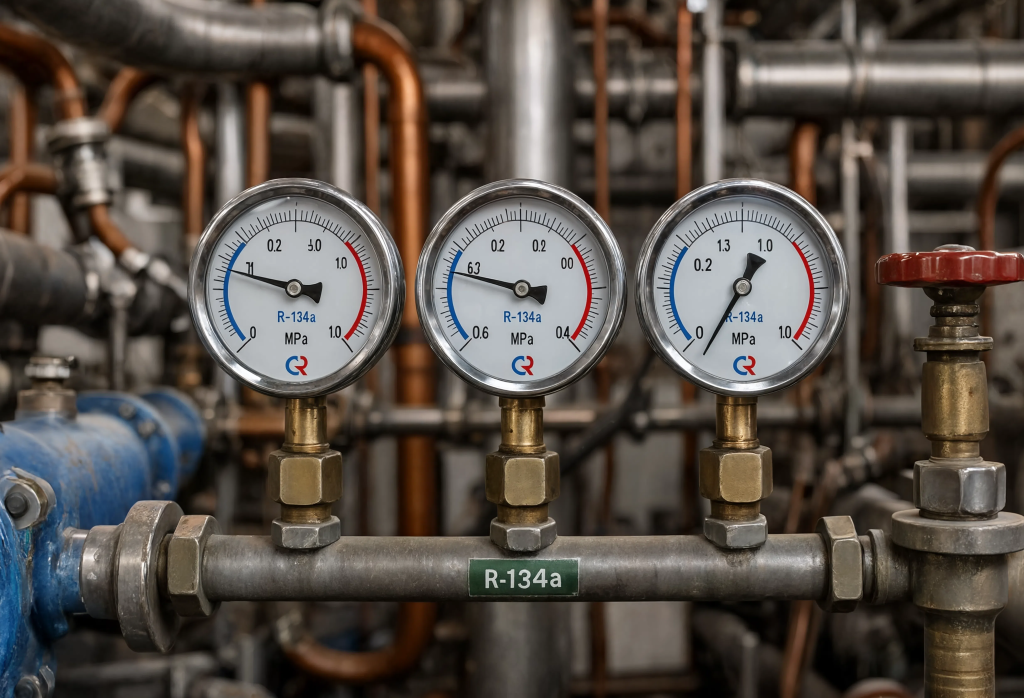
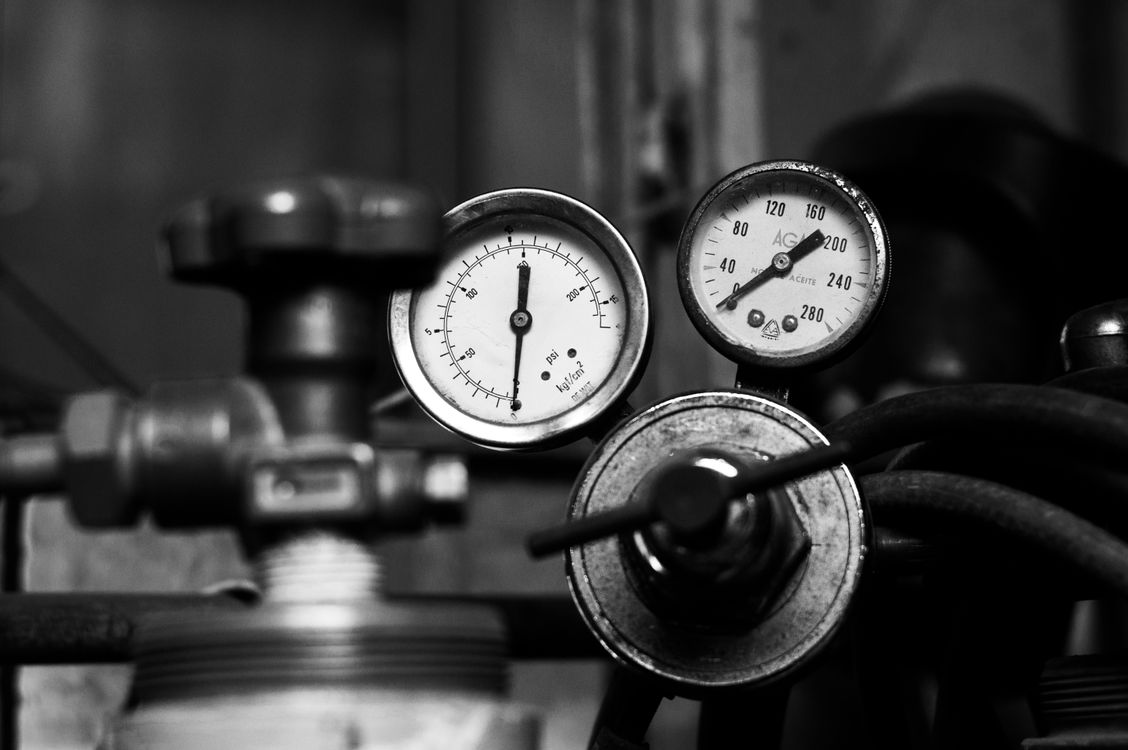
How do you use this chart in the field? Connect your gauge to the high or low side, read the pressure in bar, then find the matching row. The corresponding temperature is the fluid’s saturation temperature at that point in the circuit. The gap between that value and the actual pipe temperature gives you superheat (suction side) or subcooling (liquid side).
Why Is R-134a Classified A1, and What Precautions Apply?
The A1 classification assigned under ASHRAE 34 (confirmed by ISO 817) means R-134a has low toxicity (A) and is non-flammable (1). The occupational exposure limit (OEL) is set at 1,000 ppm over an 8-hour time-weighted average (TWA). That’s one of the reasons this gas has dominated the market for three decades: no fire risk, no flammability precautions to manage.
That doesn’t mean it can be handled without protection. A few concrete risks show up in the field:
Frostbite: R-134a boils at -26.1°C. A liquid jet on skin causes cold burns within seconds. Always wear insulated gloves and safety goggles. Asphyxiation: in confined spaces (plant rooms, pits), R-134a is heavier than air (vapor density roughly 4.2 relative to air) and can displace oxygen. Ventilate before working. Thermal decomposition: on contact with an open flame or a surface above 250°C, R-134a breaks down into hydrofluoric acid (HF), an extremely irritating gas. Never smoke near a leak.
In practice, storage isn’t a particular challenge. Keep cylinders upright, in a dry location, away from direct sunlight and below 50°C. Field reports suggest the most common incidents remain cold burns from quick-connect fittings used without gloves, not critical failures.
Which Oil Should You Use with R-134a: PAG or POE?
R-134a isn’t miscible with the mineral oils traditionally used with R-12, which means a compatible synthetic lubricant must be chosen instead. Two families dominate: PAG (polyalkylene glycol) for automotive applications and POE (polyol ester) for stationary refrigeration. Using the wrong oil causes inadequate compressor lubrication and can lead to mechanical failure within weeks (Bitzer Refrigerant Report, 2023).
| Criterion | PAG | POE |
|---|---|---|
| Primary application | Automotive air conditioning (MAC) | Commercial and industrial refrigeration |
| Hygroscopicity | High (absorbs moisture) | Moderate |
| Miscibility with R-134a | Excellent | Good |
| Mineral oil compatibility | Not compatible | Not compatible |
| Common viscosities | PAG 46, PAG 100, PAG 150 | POE 32, POE 68, POE 100 |
| Main precaution | Never expose to open air (absorbs moisture within minutes) | Reseal the container immediately after use |
What’s the most common mistake? During an R-12 to R-134a conversion on an older vehicle, failing to fully purge residual mineral oil. Just a few percent of leftover mineral oil is enough to reduce the miscibility of the blend and cause inadequate oil return to the compressor. Workshop feedback suggests a double flush with an approved solvent before recharging prevents 90% of these problems.
Where Is R-134a Still Used Today?
Despite the arrival of R-1234yf and other low-GWP alternatives, R-134a retains a massive presence across four main sectors. The MAC Directive 2006/40/EC ended its use in new cars in 2017, but Europe’s vehicle fleet still counts tens of millions of cars equipped with it. And in stationary refrigeration, no immediate ban applies to maintenance use.
Automotive air conditioning: every passenger car registered before 2017, plus many newer light commercial vehicles. Recharging and servicing remain common. Looking for a practical guide on pricing and legality? See our R-134a recharge guide.
Commercial refrigeration: supermarket display cabinets (medium temperature, +2°C to +8°C), bakery display cases, vending machines. These units typically have a service life of 10 to 15 years, which keeps R-134a in operation well beyond 2030.
Industrial chillers: high-capacity centrifugal and screw chillers (100 kW+) still use R-134a in many commercial buildings. For replacement options, compare it with R-513A and R-1234ze(E).
Other uses: propellant in medical aerosols (metered-dose inhalers) and some refrigerated transport systems. These niches rely on pharmaceutical-grade R-134a, subject to separate purity standards.
Is R-134a “Freon”? Clearing Up a Common Misnomer
No. “Freon” is a registered trademark owned by Chemours (formerly DuPont’s chemicals division, spun off as an independent company in 2015) that covers its CFC and HCFC product lines, such as R-12 and R-22. R-134a belongs to the HFC family: it contains no chlorine and has zero ozone depletion potential (ODP = 0). Technically, calling it “Freon” is incorrect.
So why does the confusion persist? Because for decades, “Freon” was used as a generic term for any refrigerant, much like “Hoover” for a vacuum cleaner. In the field, you’ll still hear technicians talk about “topping up the Freon.” If a customer or colleague uses the term, they’re probably referring to R-134a (pre-2017 cars) or R-1234yf (newer cars). To identify your system’s exact refrigerant, check the manufacturer’s label on the compressor or condenser.
What Is R-134a’s Regulatory Status in the EU in 2026?
R-134a is not banned in the EU in 2026 for servicing existing systems. The MAC Directive 2006/40/EC prohibited its use in new passenger cars from 1 January 2017 (a GWP threshold of 150 was set), but that ban applies to placing new vehicles on the market, not to servicing the existing fleet (EUR-Lex, Directive 2006/40/EC).
On the stationary refrigeration side, F-Gas Regulation III ((EU) 2024/573) doesn’t target R-134a by name but progressively cuts HFC import quotas. The price of virgin R-134a therefore rises mechanically as quotas shrink. Reclaimed gas that meets original specifications is gaining ground as a durable maintenance solution.
The precise restriction timeline by equipment category, and projections through 2032, are covered in detail elsewhere; the summary here is that HFC quota tightening, not an outright R-134a ban, is what’s driving change. If you handle refrigerant gases in the EU, remember that F-Gas certification and compliance requirements apply and vary by member state.
| Property | Value |
|---|---|
| Chemical formula | CH₂FCF₃ (1,1,1,2-tetrafluoroethane) |
| Molar mass | 102.03 g/mol |
| Boiling point (1 atm) | -26.1°C |
| Critical point | 101.1°C / 40.6 bar |
| GWP (IPCC AR4) | 1,430 |
| ODP | 0 |
| Safety classification | A1 (ASHRAE 34 / ISO 817) |
| OEL (exposure limit) | 1,000 ppm (8-hr TWA) |
| Automotive oil | PAG (polyalkylene glycol) |
| Stationary oil | POE (polyol ester) |
| Regulatory status (2026) | Banned in new vehicles (2017); servicing permitted |
Frequently Asked Questions
How do you read the R-134a pressure-temperature chart?
Take the reading from your gauge (in bar absolute), then find the matching value in the Pressure column of the chart. The temperature next to it is the fluid’s saturation temperature. Compare it to the temperature measured on the pipe to calculate superheat (suction) or subcooling (liquid). A gap of 5-8 K for superheat and 4-7 K for subcooling is typical.
Are R-134a and R-1234yf interchangeable?
No. Although their operating pressures are similar, R-1234yf is classified A2L (mildly flammable) and requires specific components. Mixing the two degrades performance and voids the warranty. R-1234yf is worth comparing separately as its own topic.
Can you still buy R-134a in the EU in 2026?
Yes. R-134a remains available for purchase by professionals who hold a valid F-Gas certification. F-Gas Regulation III is reducing import quotas, which pushes prices up, but it does not ban sales for servicing existing systems. Reclaimed gas is a cost-effective, compliant alternative.
Which oil should you use during an R-12 to R-134a conversion?
The mineral oil from the R-12 system must be fully purged and replaced with PAG (automotive) or POE (stationary) oil. A double flush with an approved solvent is recommended to remove residual mineral oil. Even a small percentage of leftover mineral oil is enough to compromise compressor lubrication.
Is R-134a hazardous to health?
R-134a is classified A1 (low toxicity, non-flammable) with an OEL of 1,000 ppm over 8 hours. The main risks are frostbite from liquid contact (-26.1°C) and asphyxiation from oxygen displacement in confined spaces. On contact with flame, it decomposes into toxic hydrofluoric acid. Wear gloves and goggles, and ventilate the work area.
What is the difference between recycled and reclaimed R-134a?
Recycled R-134a is simply filtered and dehumidified on site, with no guarantee it meets normative purity standards. Reclaimed R-134a is factory-processed to restore virgin-gas specifications (purity of 99.5% or higher under AHRI 700). Only reclaimed gas is equivalent to new gas under F-Gas Regulation III and does not count against HFC quotas.
R-134a: A Gas in Transition, Still Very Much in the Field
R-134a hasn’t disappeared and won’t disappear anytime soon. Its A1 profile, well-documented thermodynamic properties and the sheer size of the installed base make it a refrigerant every technician needs to know. This guide gives you the tools to work with it: the PT chart for diagnostics, the PAG/POE choice for lubrication, and the safety precautions for day-to-day handling.
R-134a will remain part of the European refrigerant mix for years to come, largely thanks to the size of the existing vehicle fleet and commercial refrigeration base. When you’re ready to service a system, check that your gas source is genuine and quota-compliant.
Disclaimer: the pressure and temperature values in this guide come from reference sources (NIST, ASHRAE) and are intended as a diagnostic aid. Always consult your equipment manufacturer’s documentation for exact specifications. Regulatory conditions can change; verify dates with official sources (EUR-Lex, national authorities).